Your Autistic Employee Needs Clarity, Not Cheerleading

Imagine you have a new autistic employee who has been with your company for a few months. You have provided accommodations, trained them on the daily routine, and they have settled into their regular tasks with impressive consistency and speed. On the surface, everything appears to be going smoothly.
There is one thing that stands out, though. They still ask a lot of questions, and they often hesitate before starting something new. You may assume they are just nervous, worried about getting into trouble, or carrying anxiety from negative experiences in past jobs. So you decide they probably just need a confidence boost.
You offer encouragement, tell them you believe in them, and reassure them that they will do great. To your surprise, they keep asking the same questions. Worse, the high quality and efficiency you admired in their routine work begin to slip. Projects slow down, mistakes creep in, and you are left wondering what changed.
What changed is not their ability. It is that they stopped getting the answers they needed.
What changed is not their ability. It is that they stopped getting the answers they needed.
Jaime A. Heidel
For many autistic people, asking a question has one primary purpose: to get information. While neurotypical employees might sometimes use questions to challenge authority, avoid tasks, fish for reassurance, or make conversation, autistic employees usually ask because they genuinely do not know something and need clarity to move forward.
There are exceptions, of course. Autistic people are individuals with their own personalities. Even so, assuming that a question from an autistic employee is a direct request for specific information is generally the safest and most respectful starting point.
When a literal, detail-oriented brain asks, “How should I do this part?” and receives, “You can do it” or “I trust your judgment” in return, it can feel like an error message in a computer program. The words are grammatically correct and positive, but they do not line up with the request. The brain is left spinning between two unpleasant options: repeat the question and risk being seen as annoying, or guess at the answer and risk getting it wrong.
When a literal, detail-oriented brain asks, “How should I do this part?” and receives, “You can do it” or “I trust your judgment” in return, it can feel like an error message in a computer program.
Jaime A. Heidel
For many autistic adults who have been fired without warning in the past, this is not a hypothetical fear. When encouragement replaces concrete guidance again and again, they learn that no choice is safe. Either way, they expect to disappoint you. That chronic anxiety can lead to stalls, shutdowns, and a drop in performance, even though their skills have not changed at all.
From the outside, it may look as though they have suddenly lost confidence and need even more pep talks. From the inside, they are desperately trying to decode your meaning and coming up empty.
To a literal thinker, the gap between the question and the encouraging reply can feel as absurd as this:
Autistic employee: “I am not sure how to complete this step. How do you want me to handle this section?”
Supervisor: “That is a calico cat!”
The response is upbeat and grammatically accurate, but it doesn’t answer the question.
Both responses are upbeat and grammatically fine. Neither response answers the question.
Jaime A. Heidel
Most autistic people are bottom-up thinkers. We build our understanding from concrete details up to the big picture. Clear, step-by-step information, written instructions, and defined boundaries help us see exactly what is expected. Many neurotypical people, on the other hand, are comfortable filling in gaps and reading between the lines. They use tone, facial expression, and context to interpret what their manager really means.
When you substitute encouragement for answers, you are asking your autistic employee to use a skill their brain may simply not have. You may feel you are being kind and empowering, but what they experience is confusion, pressure, and a strong sense that you are hiding the real rules from them.
This does not mean you should never encourage an autistic employee. Supportive words can absolutely help. The key is timing and content. Encouragement should come in addition to clear instructions, not instead of them.
A more helpful approach might look like this:
Autistic employee: “I am not sure how to complete this step. How do you want me to handle this section?”
Supervisor: “For this part, follow the template we used last week. Start with section A, then copy the data from the spreadsheet into section B. After that, send me a draft so I can review it before you finalize anything. If you get stuck again, come back and ask.”
Supervisor: “You did a great job on the last project. I would not have given you this one if I did not trust your skills.”
The first response answers the question. The second response adds encouragement without replacing clarity.
Another strategy that works well for many autistic employees is what I call front-loaded communication. That means laying out expectations, boundaries, and steps as clearly as possible at the beginning of a task, then inviting questions and giving direct answers as needed. This way, everyone understands the goal and process from the start, and your autistic employees are not left guessing what you “really” want.
Encouragement has its place in a healthy work environment. It can boost morale and make people feel appreciated. Just remember that for autistic employees, encouragement cannot take the place of clear information. When they ask you a question, the most supportive thing you can do is to answer it directly, in detail, and with the assumption that they are genuinely trying to do the job well.
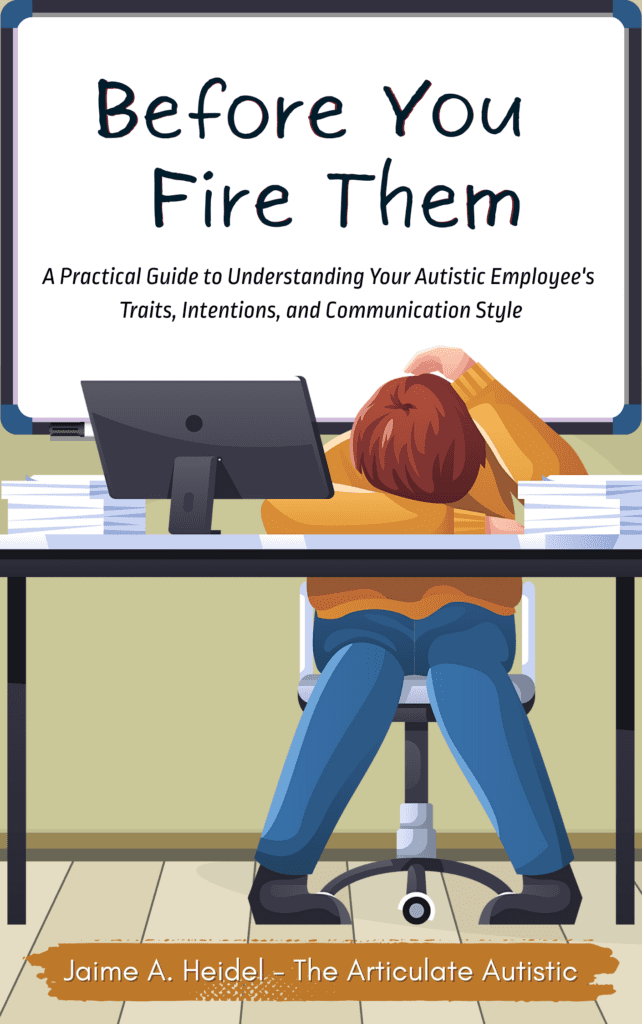
Learn more about how your autistic employee thinks, learns, and communicates by picking up a copy of my latest book, Before You Fire Them: A Practical Guide to Understanding Your Autistic Employee’s Traits, Intentions, and Communication Style.