How Autistic People Often Say ‘Thank You’ Without Using the Words

Throughout my life, I have been scolded many times for not saying “thank you” when it was expected. If someone gave me a gift, took me out, or did me a favor, there was a good chance an adult nearby would instantly prompt me with a sharp, “What do you say?”
If someone gave me a gift, took me out, or did me a favor, there was a good chance an adult nearby would instantly prompt me with a sharp, “What do you say?”
Jaime A. Heidel – The Articulate Autistic
From the outside, my silence looked rude. To the people around me, it seemed like I did not appreciate what they had done. Inside, though, I was overflowing with gratitude. I simply did not express it in the way neurotypical people were looking for.
When I received a present, for example, I might gasp, smile, laugh, and talk excitedly about how beautiful or interesting it was. Then I would dive into playing with it or examining it in detail, completely absorbed, until that familiar reminder dragged me back: “Say ‘thank you’!”
If someone took me to a movie or out to eat, I would show how happy I was by relaxing, joking, and sharing my thoughts. I would enjoy the experience fully, soak up the sensory details, and feel very close to the person I was with. Yet at the end of the day, it often did not occur to me to put the specific words “thank” and “you” together in that order.
It was not that I was ungrateful. It was that those two words felt flat and small compared to the depth of what I was feeling. They were like a black-and-white sketch trying to stand in for a vivid painting. I never forgot to feel gratitude. I simply forgot to attach that feeling to a particular social script.
When people insist that gratitude is not real unless the exact phrase is spoken, it can be baffling. Imagine someone dramatically saves your life, pulling you from a dangerous situation at great risk to themselves. In many stories, the survivor sobs out “thank you”, and that is seen as the ultimate expression of appreciation.
When people insist that gratitude is not real unless the exact phrase is spoken, it can be baffling.
Jaime A. Heidel – The Articluate Autistic
From my perspective, the tears, the visible relief, the way the person clings to their rescuer, and maybe never forgets them for the rest of their life, all seem like true evidence of gratitude. The words feel strangely small next to that. It is not that neurotypical people are wrong to value them. It is that for many autistic people, the emotional weight sits elsewhere.
None of this means autistic people lack empathy. In fact, many of us experience what could be called hyper-empathy. We feel things very intensely and often imagine in great detail how others might be feeling, even if we struggle to express that understanding in socially conventional ways.
So if the autistic person in your life rarely says “thank you” without prompting, try not to assume they do not care. Instead, look at what they do.

Do they light up when you walk into the room? Do they share their special interests with you, or do they listen closely when you talk about yours? Do they relax their body around you, stim freely, or let their guard down in ways they do not with other people? Do they make brief eye contact or offer a hug, even if those actions are usually uncomfortable for them?
These are all ways an autistic person may be saying, “I feel safe with you” and “I appreciate you” without using those exact words.
Of course, there is still value in teaching and practicing the verbal phrase, especially in cultures where it carries significant weight. Knowing when and how to say “thank you” can protect autistic people from misunderstandings and hurt feelings in a world that often judges them too quickly.
The Takeaway
At the same time, it is helpful for neurotypical family members, friends, and colleagues to remember that words are only one channel of communication. When you broaden your view of what gratitude can look like, you are more likely to see how deeply your autistic loved one cares, even when their social scripts do not match your expectations.
Gratitude in autistic people is rarely missing. It is simply spoken in a slightly different language. If you learn to recognize that language, you may realize you have been thanked more often than you ever knew.
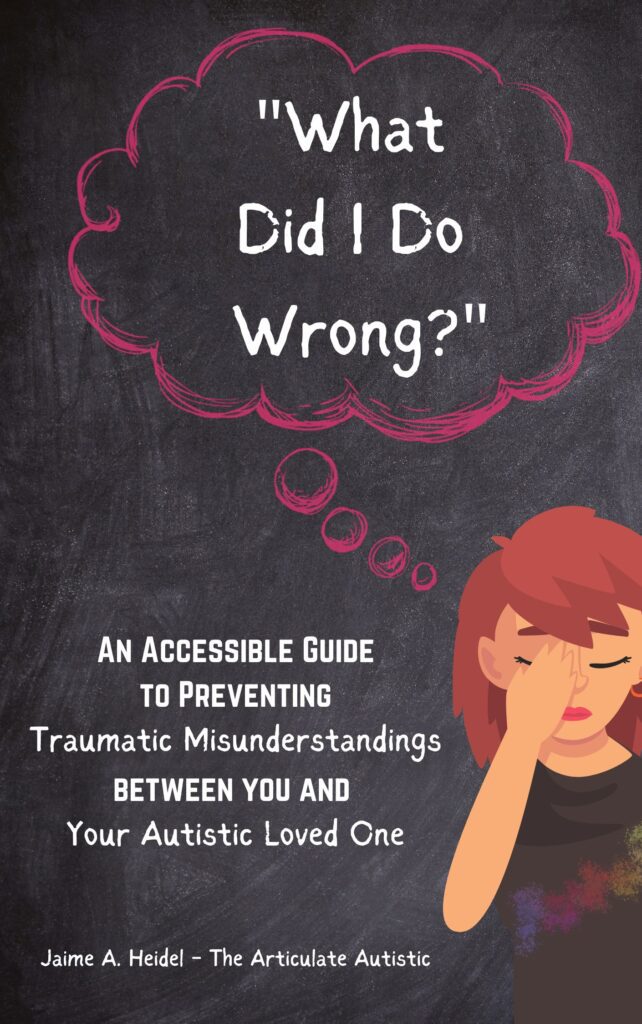
If you have frequent misunderstandings with your autistic loved one, get a copy of my book, “What Did I Do Wrong?”: An Accessible Guide to Preventing Misunderstandings Between You and Your Autistic Loved One by clicking the photo below!