Helping Your Autistic Employees Understand Your Instructions
One of the traits people often associate with autism is literal thinking. Autistic people tend to take words at face value, and this can lead to misunderstandings in both personal and professional settings. In the workplace, those misunderstandings are sometimes misread as sarcasm, laziness, or an attempt to be clever at someone else’s expense.
In reality, when an autistic employee follows your words exactly, they are usually doing their best to cooperate. Their brain is processing your instructions differently, not trying to make you look foolish. The good news is that a few changes in how you communicate can make things easier for everyone on your team.
When an autistic employee follows your words exactly, they are usually doing their best to cooperate. Their brain is processing your instructions differently, not trying to make you look foolish. The good news is that a few changes in how you communicate can make things easier for everyone on your team.
Jaime A. Heidel – The Articulate Autistic
Imagine you are a supervisor who has to leave the office about an hour before an important meeting you were scheduled to lead. On your way out, you quickly tell your administrative assistant, Genevive, to call everyone and cancel the meeting, then you rush out the door without saying anything else.
Genevive is autistic. She notices your urgency and senses that the situation is serious. Her brain immediately switches into task mode. She sits down with the list of attendees and calls each person to tell them the meeting has been canceled. Once she has reached everyone, she considers the task complete and goes back to the project she was working on before.
Not long after, you start getting messages from several attendees. They want to know why the meeting was canceled, whether it will be rescheduled, and what they should do with the time they had set aside. You feel frustrated. In your experience, other assistants have automatically explained and apologized for the inconvenience, and proposed a new time without being told.
From your perspective, it seems obvious that this is what “cancel the meeting” includes. You assumed Genevive would fill in all of those gaps. From Genevive’s perspective, she has done exactly what you asked. You did not mention an explanation, an apology, or a new date, so those steps never made it onto her mental checklist.
From your perspective, it seems obvious that this is what “cancel the meeting” includes. You assumed Genevive would fill in all of those gaps. From Genevive’s perspective, she has done exactly what you asked. You did not mention an explanation, an apology, or a new date, so those steps never made it onto her mental checklist.
Jaime A. Heidel – The Articulate Autistic
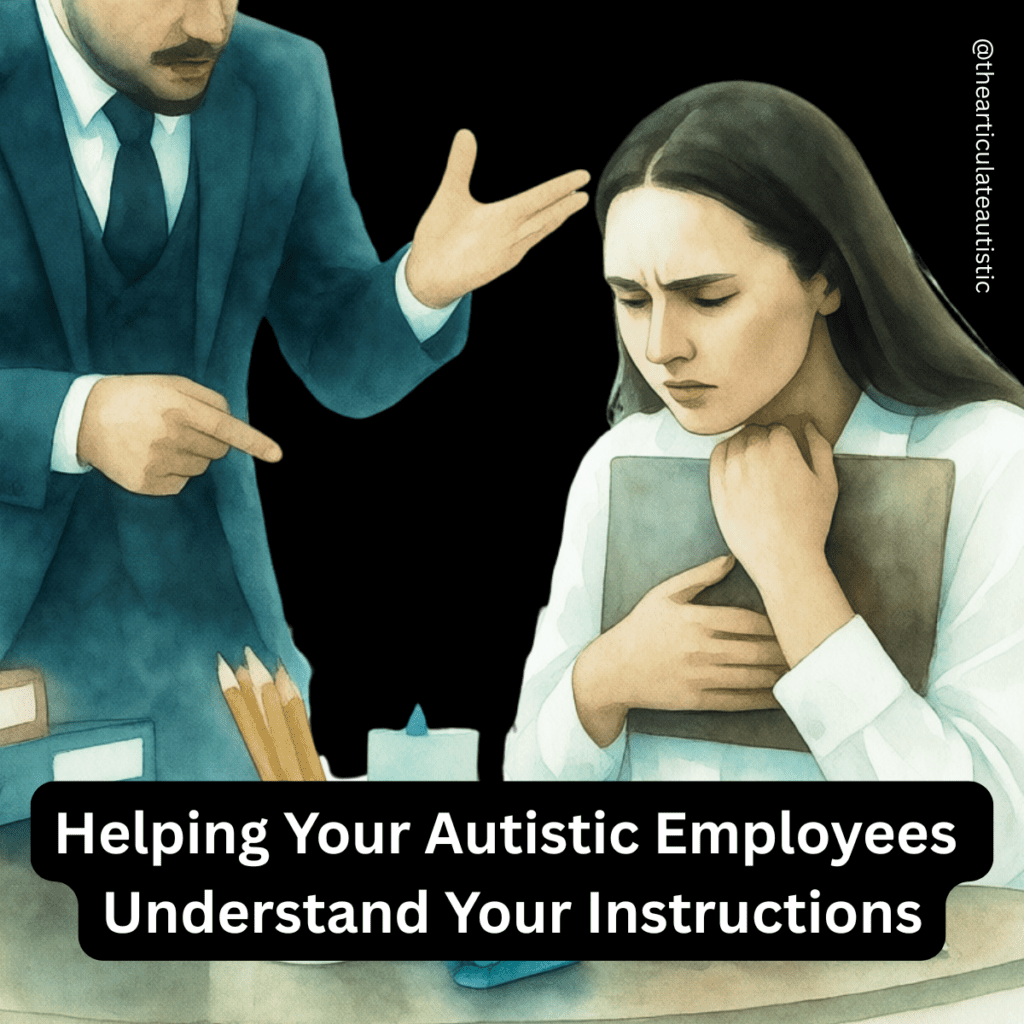
If you call Genevive into your office in an agitated state and scold her for failing to do the unspoken parts of the task, she will likely feel blindsided and hurt. She may lose trust in you and in her own judgment.
After all, she followed your instructions word for word. Somehow, that still was not enough.
It is important to remember that communication styles are influenced by many factors, not just neurotype. Culture, industry, generation, and prior workplaces all shape what seems “obvious” to a person. Autistic employees may be more likely to take instructions literally, but they are not the only ones who benefit from clear expectations.
Instead of relying on unwritten rules, consider creating explicit protocols for common tasks. In the meeting example, you might document a standard process that says: when a meeting is canceled, the assistant will notify attendees, briefly explain the reason if appropriate, apologize for the inconvenience, and either suggest a new time or note that rescheduling information is coming soon.
Make that protocol available to everyone, not just autistic employees. Go over it in writing and, if possible, with simple visual aids such as flowcharts. That way, all of your staff know what “cancel the meeting” actually includes in your department, and nobody has to guess at your expectations.
These kinds of adjustments reduce confusion and frustration across the board. They also show autistic employees that they are not being singled out as a problem. Instead, you are building a system that recognizes different communication styles and provides a structure that supports everyone.
Another helpful mindset shift is to assume positive intent. If an autistic employee does exactly what you said and no more, resist the urge to read it as passive-aggression. Start with the idea that they were trying to do a good job, according to the information they had. From that foundation, you can talk together about what needs to change for next time.
Many autistic people have experienced abrupt, unexplained job losses in the past. When a new supervisor responds to literal compliance with anger or sarcasm, it can trigger old fears and make work feel unsafe again. By contrast, when you respond to misunderstandings with curiosity and clarity, you help rebuild that sense of safety.
The Takeaway
Clear, concise instructions and consistent protocols are not only an accommodation for autistic staff. They are also smart management practices. They reduce the risk of things slipping through the cracks, cut down on repeated questions, and make your expectations transparent.
When everyone knows what your words actually mean in practice, your autistic employees are less likely to feel like they are walking through a minefield, and your whole team can spend more energy on the work itself instead of decoding each other.
Better understand your autistic employee’s traits, intentions, and communication style by picking up a copy of my book, Before You Fire Them.