“Is My Employee Autistic?”
If you’ve noticed that one of your employees seems to stand out in a way you can’t quite put your finger on, you may be wondering if they’re autistic.
This article offers 10 signs you may have an autistic employee.
10 Signs Your Employee May Be Autistic
Before I start, I’d like to remind you that only a medical professional can diagnose autism.
However, there may be traits and communication styles your employee displays that differ from your neurotypical employees, and you want to learn more.
Here are 10 signs your employee may be autistic:
1. Asks frequent questions
Autistic people are bottom-up thinkers and learners. We need more details to understand the full picture. While neurotypical employees are the opposite, starting with the full picture and working their way down to the details.
This is why your autistic employee asks so many questions. They’re trying to learn and understand, not undermine your authority, question you personally, or attempt to get out of work.
The details you think are unimportant to the task are what the autistic employee needs to complete it.
2. Expresses a strong need to know ‘why’ your company does things the way it does
Another sign that your employee could be autistic is that, after training, they become curious about why things are done a certain way.
At first, this may come across as rude or insubordinate, but they’re not questioning your competence; the details of why something is done a particular way help them understand their specific role in completing the project.
3. Takes your instructions literally
Another sign that your employee may be autistic is that they take your instructions literally. For example, let’s say you run a restaurant and tell your employee to wash the dishes before their shift ends. An hour later, you go back to the kitchen to check the dishes are done. They are, but nothing else has been taken care of.
You expected that “do the dishes” conveyed that they were also to dry them, put them away, clean the countertops, and sweep the floor.
At first glance, it may look like they’re being lazy or practicing malicious compliance. They aren’t. Their brains focus primarily on the spoken or written word, not non-verbal communication, as they have difficulty reading nuance, facial expressions, and body language.
What you think “goes without saying” needs to be explicitly conveyed to the autistic person without leaving anything out.
What you think “goes without saying” needs to be explicitly conveyed to the autistic person without leaving anything out.
Jaime A. Heidel – The Articulate Autistic
4. Turns in assignments earlier than expected
Oftentimes, autistic employees go above and beyond what’s expected of them, turning in assignments earlier than the rest of their colleagues.
When an autistic employee hears, “Give 100%”, they take the phrase literally, and that’s exactly what they do!
Unfortunately, neurotypical coworkers often resent the autistic employee for completing their work so fast, as they feel it makes them “look bad”. It can also seem to the manager that they’re “kissing up”, or that they have an “angle” of some sort.
None of these are true of your autistic employee. They want to be efficient at their job, and they may not even notice everyone else around them is working at a much slower pace.
5. Does not socialize with coworkers, even on break
If your employee fits the description of “loner”, they may be introverted or autistic.
When an autistic employee spends their day giving 100% while also dealing with sensory overload, they burn out faster, and they don’t have the energy to socialize.
They use their lunch and break times to recover and recharge.
They aren’t trying to be rude or standoffish. Socializing can be very draining for your autistic employees, and they’re just trying to preserve their energy.
6. Suggests more efficient ways of doing things
Another sign your employee may be autistic is that they think nothing of telling you, their boss, how you could improve your workflow. They intend to make things more streamlined, efficient, and profitable, but they unintentionally come off as rude, insubordinate, or “acting above their pay grade”.
Autistic people don’t have the same relationship with social hierarchy as you and your neurotypical employees do, so it would never occur to them that offering their boss time-management techniques might be frowned upon.
7. Talks about the same subject for a long time, even when others lose interest
While many autistic people avoid socializing as a way to preserve their energy, other autistic people are more extroverted and seek conversation. Where things go wrong, however, is when the autistic person discusses only one subject at length, regardless of whether their listening partner is interested.
This may seem selfish or even narcissistic, but that’s not the intent.
Your autistic employee is excited they found something in common with the listener and continues speaking about the same subject because they have a monotropic brain, meaning they have a deep focus and knowledge on one or two subjects, which is why they spend the majority of their social time talking about them.
Since nuance, facial expressions, and body language are often lost on the autistic person, they may not realize that the people around them are showing signs that they’ve grown weary of the conversation.
8. Gets easily agitated when interrupted
Interrupting an autistic person in hyperfocus is a bit like hearing a fire alarm going off in your house in the middle of the night. It’s jarring and anxiety-producing.
When an autistic person is in hyperfocus, they are so deep into their work that they cease to notice anyone or anything around them. So, when a coworker comes up for a quick chat about their weekend, it’s like that fire alarm going off, jarring and anxiety-producing for the autistic brain.
Plus, being interrupted in hyperfocus may cause the entire project to derail, making them have to start all over again and potentially miss deadlines.
9. Displays a blank or angry facial expression and vocal tone
Another possible sign your employee may be autistic is that they have a “flat” facial expression and a monotone voice. This may make them seem angry when they’re perfectly content.
Unfortunately, since non-verbal communication is the primary way neurotypical people convey feelings and intentions, it’s easy for them to get confused and even frightened when they can’t read a person.
10. Gives only the information you ask for without elaborating
Another sign your employee may be on the autism spectrum is that they only give you the information you asked for without elaborating.
For example, when you ask, “Did you get this project done?” they may answer, “Yes.” No detail, no elaboration, and certainly no awareness that you asked about the project because you wanted them to hand it to you.
A Book That Helps You Better Understand and Support Your Autistic Employees
It’s possible that your autistic employee doesn’t know they’re autistic, or they do, but they don’t feel safe enough to disclose.
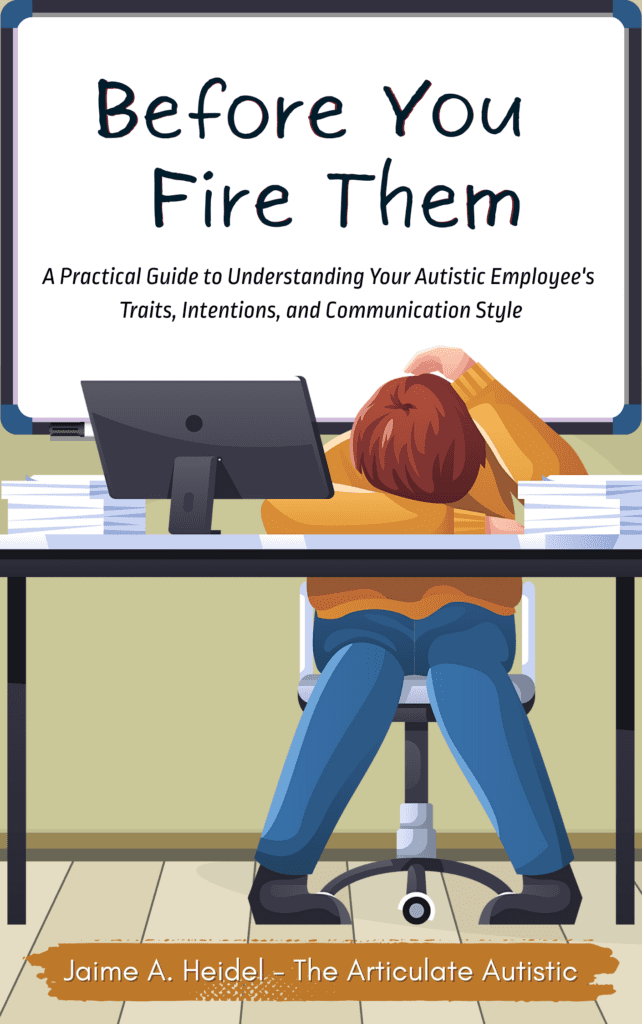
Learn how to better understand and support your autistic employee by picking up your copy of my book, Before You Fire Them: A Practical Guide to Understanding Your Autistic Employee’s Traits, Intentions, and Communication Style.






Not one of my bosses ever thought to ask the question. But the severance pay packages paid my mortgage off early. Thanks.