Think Twice Before Interrupting an Autistic Co-Worker at Work

In many offices, small talk is part of the culture. Neurotypical employees often enjoy swinging by a desk to chat about weekend plans, last night’s game, or the latest TV show. These quick conversations can feel like a welcome break and a way to connect.
For many autistic people, it feels very different. Even light-hearted topics can be hard to navigate, especially if we do not understand the social purpose behind them or if they do not feel authentic to us. And when small talk interrupts deep focus, the impact can be much more than a minor annoyance.
Small Talk Meets Task Inertia and Hyperfocus
Autistic and ADHD people often describe something called task inertia. It can be very hard to start a task, but once we finally get going and fall into hyperfocus, it can be just as hard to stop.
Hyperfocus is not simply “paying attention.” It is an intense, immersive state in which many threads of thought, images, and ideas are connected and moving together.
Picture an autistic employee sitting at their desk, working steadily. Above their head, you could imagine dozens of colored threads weaving into a complex pattern that represents all the connections their brain is making.
When someone interrupts them for casual conversation, it can feel like a pair of scissors has cut through those threads. The mental image disappears, the connections go dark, and the flow is gone.
If the interruption is about a fire alarm or an urgent safety issue, that painful jolt is worth it. If it is about weekend plans or a new show on streaming, the emotional cost far outweighs the benefit.
After an interruption like that, it may take an autistic or ADHD person a very long time to rebuild their momentum. That is why “just a quick chat” can seriously reduce productivity rather than boost it.
Masking on Top of Hyperfocus
There is another layer that many people do not see. When autistic people are deep in hyperfocus, they are usually not masking. Their face may be neutral, their body posture may look “closed,” or they may be stimming in ways that feel comfortable in the moment.
They may also be so absorbed in their work that they do not notice you until you speak. The sudden sound of your voice can startle them so much that they literally jump.

Going from unmasked hyperfocus to “professional” in three seconds is exhausting. We have to pull our body and face into a shape that looks friendly enough for neurotypical expectations while our nervous system is still reeling from the shock.
Even if we manage to smile and sit up straight, the way we flinched or gasped when you spoke may leave you feeling awkward, wondering if we dislike you. You walk away confused and maybe hurt. We are left shaken and dysregulated. All of this, just because of a non-urgent chat.
Choosing Better Ways to Share Information
None of this means you should never approach an autistic co-worker. It does mean you should choose your timing and method with care.
If what you need to say is truly urgent or time-sensitive, then yes, interrupt them. Just be aware that the reaction you see might be startle plus overload, not anger or disrespect.
If the information can wait, consider sending an email or instant message instead of walking up to their desk or calling them on the phone. That way, they can wind their “thought threads” back at their own pace, rather than having them abruptly cut.
This approach lets you include them in important discussions without forcing them into repeated, jarring transitions out of hyperfocus.
The Takeaway
For many neurotypical people, interruptions are welcome breaks in the day. For many autistic people, those same interruptions can feel like having the power shut off in the middle of a complex task.
We are not asking to be ignored. Most of us want to be part of the team. We simply need colleagues to be thoughtful about when and how they approach us. Saving non-urgent small talk for better moments and using written communication where possible can make daily life at work far less painful for your autistic co-workers while still keeping them fully included.
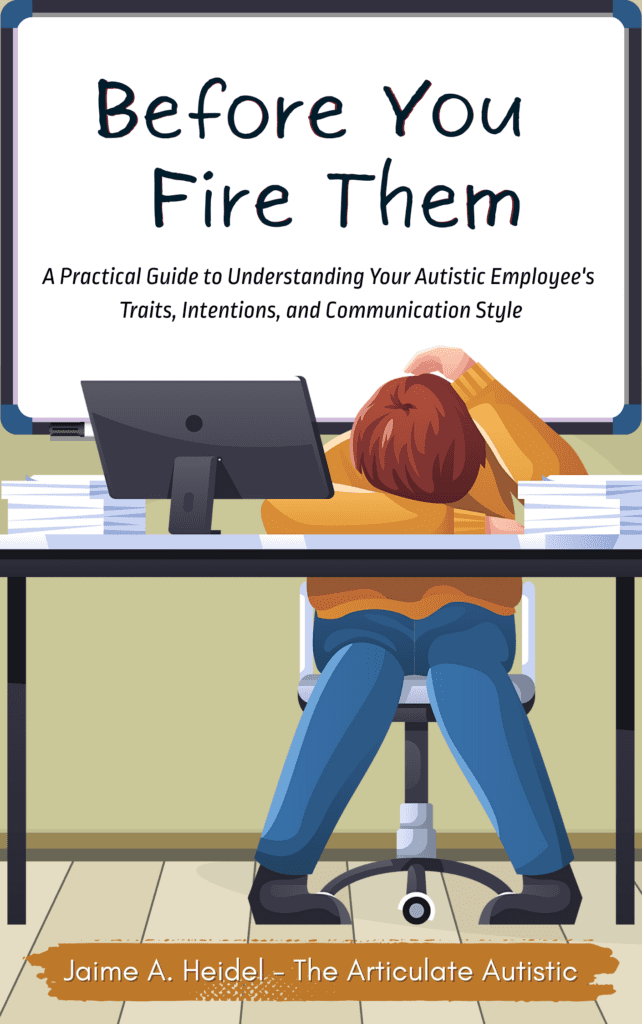
Better understand your autistic employees’ traits, intentions, and communication style by picking up a copy of my book, Before You Fire Them!