How Your Autistic Employees Prefer to Receive Instructions
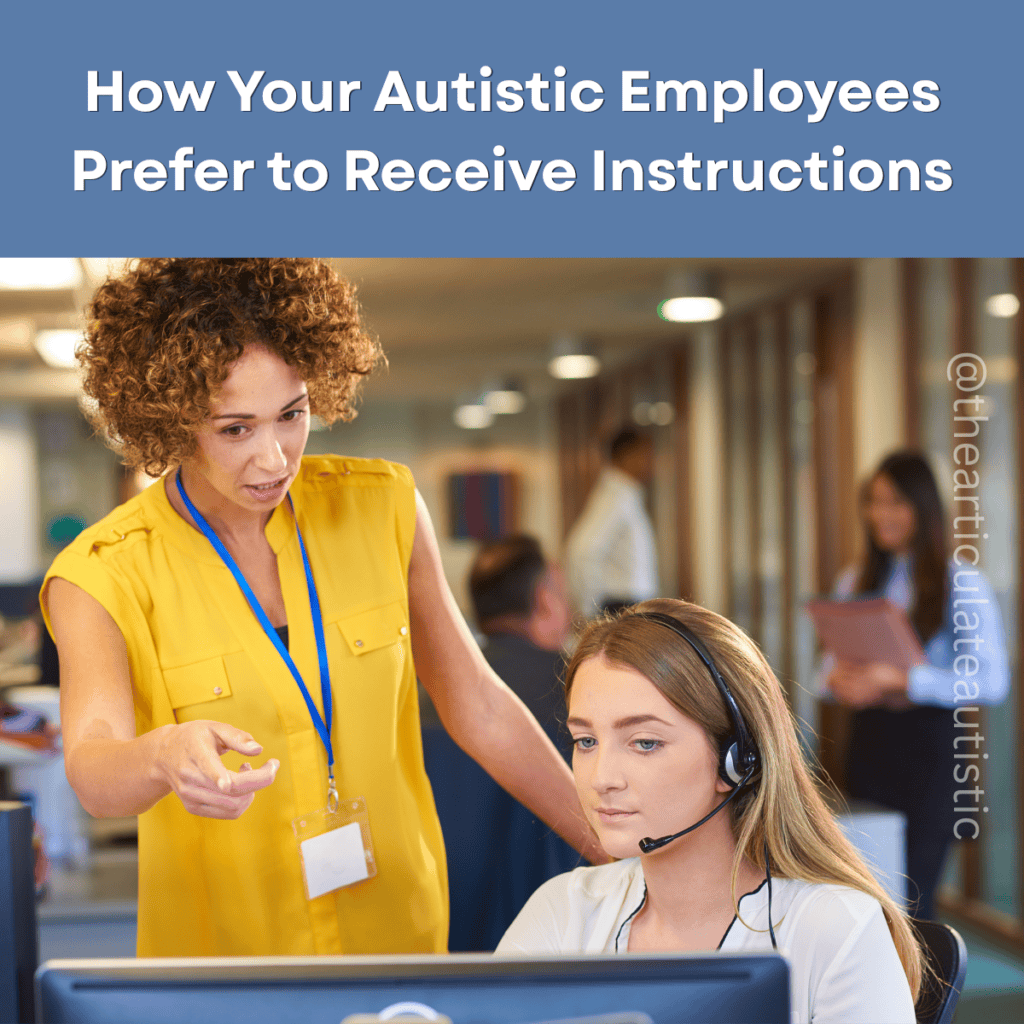
As a manager, you may have noticed that your autistic employees sometimes struggle to understand your instructions or training. This can be frustrating for you both and can put a strain on your working relationship.
The piece you may be missing is that, even though you’re a good trainer, you’re not teaching your autistic employee the way they learn, so your instructions are either only partially accessible or inaccessible to them.
How Your Autistic Employees Prefer to Receive Instructions
I’ve asked the autistic community which methods they prefer when being taught a new skill, and overwhelmingly, these have been the responses:
- Writing
Written instructions are the most preferred learning method, by far. Verbal instructions followed by written instructions also work. After receiving written instructions, your autistic employee can refer back to them anytime they forget a step or get stuck.
After receiving written instructions, your autistic employee can refer back to them anytime they forget a step or get stuck.
Jaime A. Heidel – The Articulate Autistic
- Showing
The second most preferred training method for autistic employees is showing. This means doing the steps while the autistic employee watches, as they may be a visual learner.
- Doing
The third most popular method is to give them instructions as they do the work. This hands-on experience can help make better sense of the instructions as you teach them. They may not get it right away, but the more you allow them to do the steps by themselves while you watch and course-correct when needed, the more they’ll get familiar with it and remember the sequence.
Another Helpful Method for Training Autistic Employees
If the training is complicated with several steps and offshoots of those steps, a good training method is scaffolding.
With scaffolding, instead of teaching all the skills at once, you start from step one, help them achieve mastery of that step, then move on to step two, building on the first step and helping them achieve mastery of that step, then step three, building on the first two steps and helping them achieve master of that step, and so forth until they learn the whole process.
While your neurotypical employees usually start with the full picture and work their way down, many of your autistic employees are bottom-up learners, meaning they start with the details and build on them to form the complete picture.
Autistic Employees Struggle Most With This Type of Instruction
- Verbal
Verbal instructions can be difficult for your autistic employees due to poor working memory, poor short-term memory, delayed auditory processing, or executive dysfunction. If you give verbal instructions, allow the autistic employee to write things down, but keep in mind that they may ask lots of questions as they hunt for the details necessary to form that all-important complete picture.
How to Accommodate Your Autistic Employees
The best way to accommodate your autistic employees is to ask and respect the way they learn, and then teach them in that manner. When you do, you’ll notice fewer questions, fewer mistakes, and enhanced productivity.
The Takeaway
Your autistic employees want to do the best job they can. They’re not pretending to be confused or slacking off; they just need to be taught the way they learn. And when that happens, the whole office will reap the rewards!
Better understand your autistic employee’s traits, intentions, and communication style by picking up a copy of my book, Before You Fire Them.