10 Important Things to Know When You’re Training an Autistic Employee

Training an autistic employee? If you’re unsure of how best to train your autistic employee because you’re unfamiliar with neurodivergence, that’s OK. This article will help you get up to speed so that your autistic trainee can do the same.
- Get to know your employee
Before you start training, get to know your autistic employee.
Your autistic employee isn’t going to think, act, or learn like their neurotypical counterparts. This is why it’s helpful to get a feel for them first and ask them directly how they learn best and what accommodations they need.
- Be literal and direct
When training your autistic employee, be literal and direct in your language. Avoid idioms, sarcasm, and double meanings. Also, even if you’re used to your neurotypical employees understanding and responding to your subtle cues during training, it will not be like this with your autistic employee. It will go over their heads, and a part of their training will go along with it. This can cause them embarrassment and shame and negatively affect your working relationship.
- Provide written follow-ups
When training an autistic employee, follow up your instructions in written form. Briefly explain what they’ve learned today and what they will be learning tomorrow. Allow follow-up questions no matter how many there are.
- Use modeling to train
Sometimes, to train an autistic employee according to their brain type, modeling can help since the employee will be able to physically see the steps they’re supposed to learn. For example, do the task step by step in front of them while letting them watch and take notes.
An alternative method is to have the autistic employee do the task themselves while you watch, gently guiding them if they miss a step.
- Establish and adhere to routines
If your autistic employee meets with you directly and you train them in a spare office, don’t deviate from that routine. If, for some reason, you have no choice but to change things around, let your autistic employee know ahead of time (at least the night before) who will be training them and where.
- Provide accommodations
Every autistic person is different, so accommodations should be given on an individual basis.
Some accommodations include allowing headphones, letting them have and use stim toys (sensory aids), allowing frequent breaks, letting them work alone in an office, covering fluorescent lights, and not reprimanding them for needing to eat and take their breaks alone to recharge.
Again, if you’re not sure what your autistic employee needs, just ask them!
- Share meeting topics ahead of time
For any meeting your autistic employee will attend, share your topics and agenda ahead of time. This way, they’ll have a chance to review them and process their thoughts at their own pace. Then, when the meeting occurs, they can contribute without feeling like they’ve been put on the spot.
- Allow them time to process
When training your autistic employee, they may appear rude, lazy, or disrespectful if they don’t answer you right away. Many autistic people need more time to process your questions before they can answer verbally. Just give them a little time.
- Reduce sensory overload
During training, be sure to reduce sensory overload. For example, use an office away from the noises of the main office, close the door, put on some white noise, and reduce light levels to make the process more comfortable.
- Allow and answer questions
One of the most important things you can do when training your autistic employee is to allow and answer questions.
While neurotypical people have a top-down learning and thinking style, meaning they start with the full picture and work down into the details, autistic people are exactly the opposite. They need every detail possible to build the full picture of what’s expected of them.
This means they will ask a lot of questions, and answering them in literal, direct ways will go a long way in helping them connect with the material.
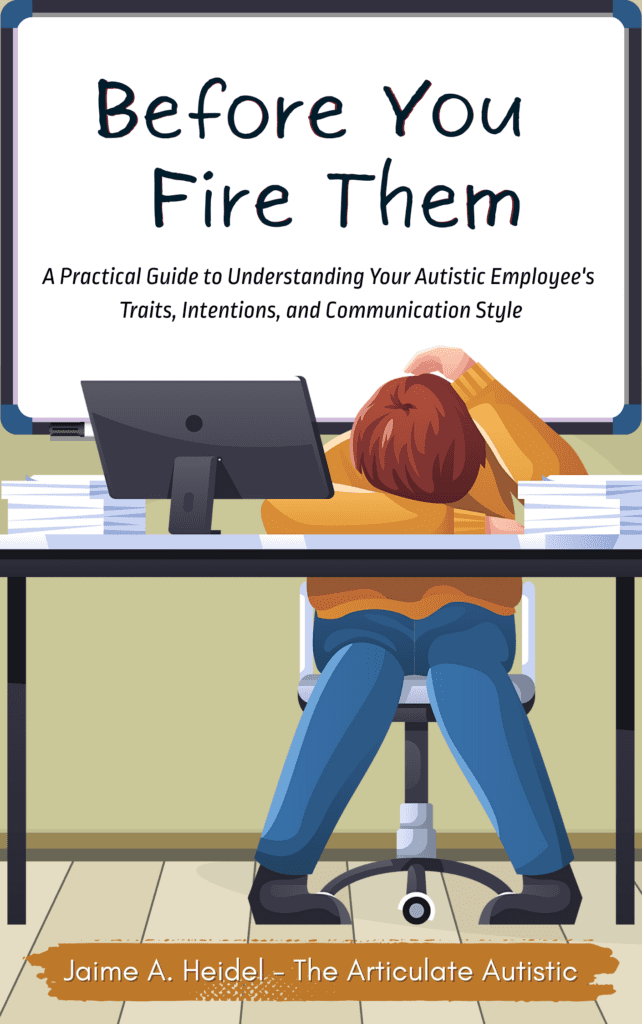
Before You Fire Them
Every autistic person has specific ways of learning and processing information. Once you work together to discover what those are, the smoother your training will go, and you’ll experience fewer delays and uncomfortable misunderstandings.
If you want to learn more about training your autistic employees as well as their traits, intentions, and communication style, pick up your copy of my book, Before You Fire Them.
Available online wherever books are sold!