Why Autistic Career Growth Should Not Depend on Socializing

One of the main reasons many autistic people struggle in the corporate world is not a lack of talent or effort. The problem is that workplaces tend to reward a different focus than the one our brains naturally have. When an autistic person starts a job, their primary concern is usually learning the tasks, doing them correctly, and meeting expectations. When a neurotypical person starts a job, their primary concern is often building relationships, navigating office politics, and climbing the social ladder.
Because this difference is rarely discussed at home, in school, or during onboarding, it remains invisible. No one pulls the autistic worker aside to explain that informal socializing and being seen as “likable” will heavily influence how far they can advance. As a result, an autistic employee can be set up for years of confusing, painful experiences at work, even when their performance is strong.
An autistic employee can be set up for years of confusing, painful experiences at work, even when their performance is strong.
Jaime A. Heidel – The Articulate Autistic
Different Priorities at Work: Getting the Job Done vs. Climbing the Ladder
When I started my first job at sixteen, working the register at a CVS, my focus was crystal clear. I wanted to learn how to operate the cash register, ring people up as quickly and accurately as possible, and remember which number to dial if I needed the manager. My brain locked onto those concrete tasks. I was there to work, so I worked.
Smiling at customers, offering small talk, and asking about their day never even occurred to me. No one ever explained that these things were not just optional extras; they were expected. Most neurotypical people pick up these social rules automatically, so they do not think to say them out loud. From my perspective, I was doing exactly what I was hired to do. From a neurotypical perspective, I probably looked cold, unfriendly, or uninterested.
For Autistic Employees, Knowledge Matters More Than Connections
As I got older and moved through different jobs, I slowly learned through painful trial and error that doing my work correctly, quickly, and efficiently was only part of what my employers expected. I was also supposed to socialize smoothly with customers and coworkers. It took me more than a decade to recognize that my brain simply could not juggle both at the same time.
If I focused on chatting with customers, my accuracy dropped. If I focused on accuracy, I forgot to chat. There was no effortless multitasking. Every interaction felt like a choice: either do the job well or try to perform social behavior that did not come naturally to me.
In the neurotypical model of corporate life, there is a familiar saying about advancement: “It’s not what you know, it’s who you know.” For a long time, that phrase made no sense to me. My literal, logical brain believed that promotion should be about competence. Eventually, I understood that what people really meant was that career growth depends heavily on being liked, networking, and fitting in socially.
That realization landed like a punch to the gut. I knew I was at a serious disadvantage. My difficulty with typical social behavior meant that, no matter how well I performed, I would struggle to be seen as promotion material. As an autistic person, my brain focuses on what I know and how I can use that knowledge to do my job well. It is not wired for effortless small talk or constant relationship management.
I can imitate neurotypical social behavior for short periods through masking, a strategy many autistic people use to blend in. But masking is exhausting and harmful to my mental health over time. It is not a sustainable foundation for a career.
How Constant Socializing Drains Autistic Workers
In my corporate years, everyday socializing with neurotypical coworkers was not just confusing, it was overwhelming. On top of the casual conversations during the workday, I was expected to attend happy hours, company parties, and team-building events in order to be considered a “team player.” When I was younger, I could mask for longer stretches and push myself through these situations, but the cost was still high. I went home drained, not refreshed.
Why Your Autistic Employee May Avoid “Chit-Chat”
For many autistic people, the social interaction they are expected to manage during the workday is already intense. Unlike neurotypical coworkers, who seem to weave socializing into their routines without thinking about it, autistic employees often have to consciously switch gears in their brains every time they are interrupted. Each shift away from a focused task makes the day more tiring.
The more an autistic person’s mental and physical resources are depleted, the more their job performance can suffer and the more vulnerable they become to burnout. When they are repeatedly pulled away from their tasks to socialize, they may feel distressed, overwhelmed, or agitated. In that state, snapping at a coworker or sounding abrupt becomes more likely, which can lead others to label them as “difficult” instead of recognizing how overtaxed they are.
When [autistic employees] are repeatedly pulled away from their tasks to socialize, they may feel distressed, overwhelmed, or agitated.
Jaime A. Heidel – The Articulate Autistic
Advancement Needs to Be Based on Performance, Not Popularity
If we want workplaces to be accessible to autistic employees, we need to take their brain wiring into account and adjust how we evaluate their success. That includes practical accommodations like written communication, breaking information into smaller chunks, flexible schedules, and remote work options. It also includes a shift in how we measure career potential.
Autistic employees should be evaluated on their job performance, reliability, and dedication, not on their willingness or ability to socialize at happy hours or join every optional event. When someone who finds social interaction confusing or exhausting is labeled a “problem employee” or “not a team player,” the environment can turn hostile. Neurotypical office bullies may target them. Promotions can slip away. Firings can happen for reasons the autistic employee cannot easily change.
We do not always frame it this way, but excluding or punishing an autistic person because they do not socialize like a neurotypical person is a form of discrimination. It is no more fair than punishing someone who uses a wheelchair because they need a mobility aid to get around. The fact that a disability or difference is invisible does not make it less real or less deserving of accommodation.
The fact that a disability or difference is invisible does not make it less real or less deserving of accommodation.
Jaime A. Heidel – The Articulate Autistic
The Takeaway
Career advancement should not depend on how well someone can pretend to be neurotypical. For autistic employees, success becomes more attainable when workplaces honor what we bring to the table, remove unnecessary social barriers, and base progress on the quality of our work rather than the volume of our small talk.
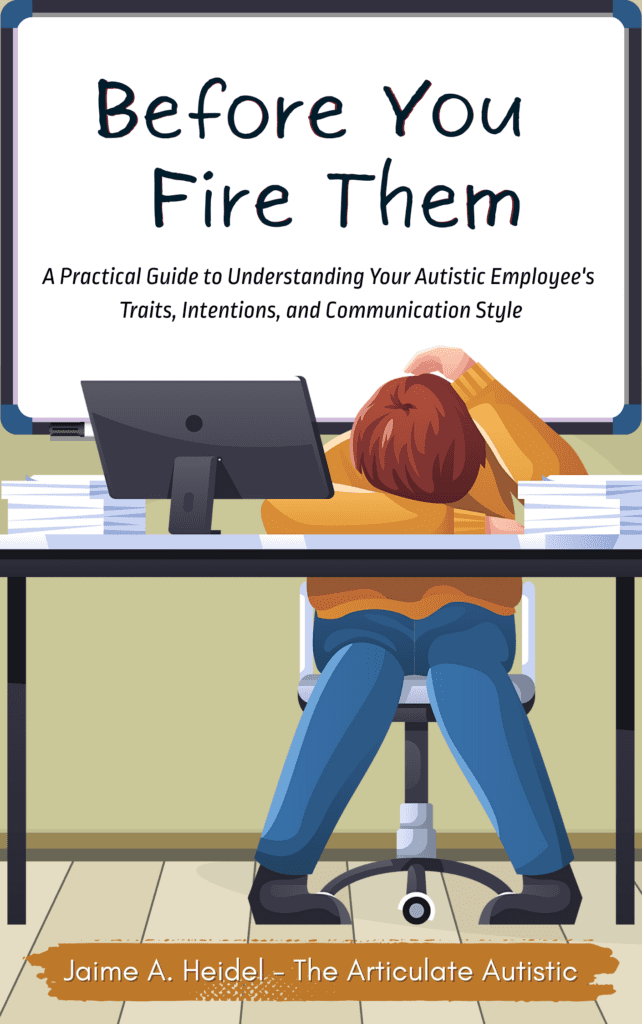
Learn more about how communication styles differ between autistic and neurotypical employees by picking up your copy of my book, Before You Fire Them: A Practical Guide to Understanding Your Autistic Employee’s Traits, Intentions, and Communication Style.
You’ll learn how to boost productivity, improve employee morale, and reduce friction in the workplace from day one!