Why Autistic People May Not Understand Your Reaction to Their Behavior
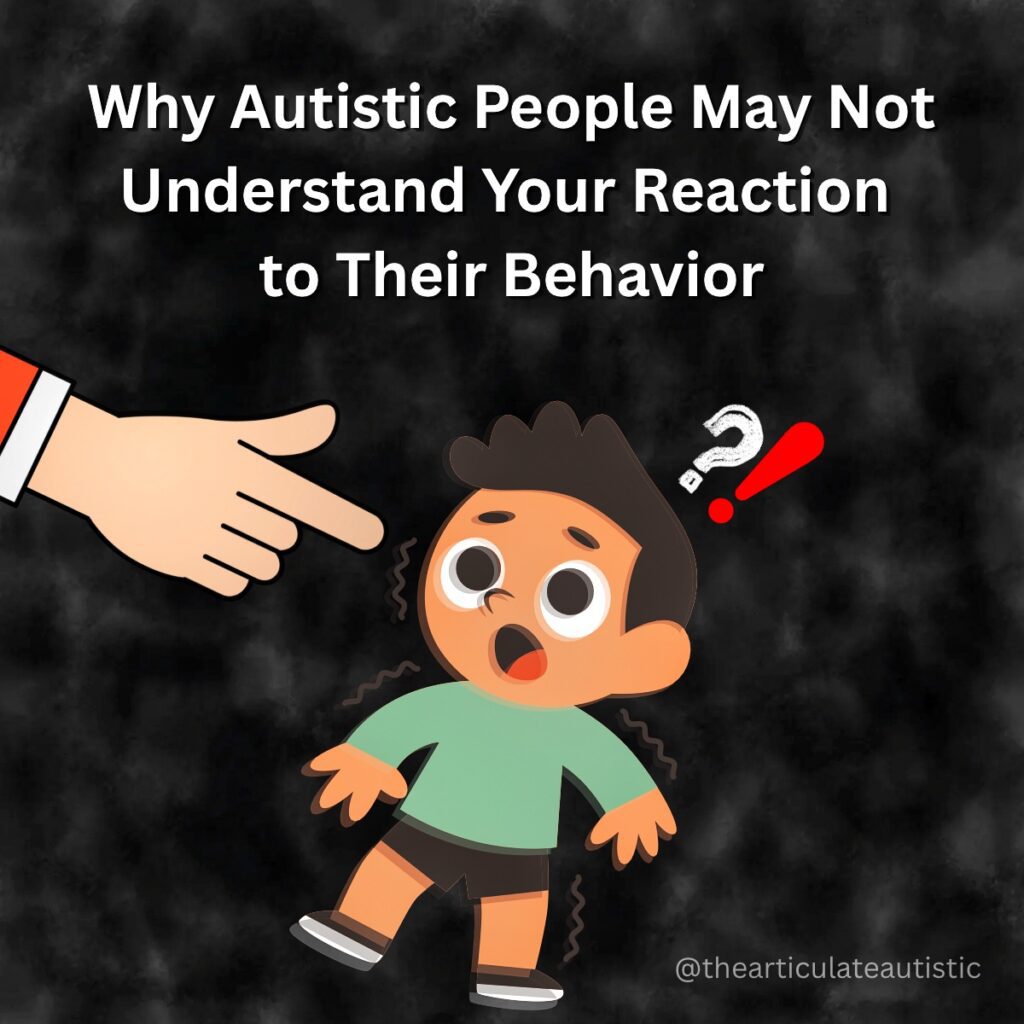
One of the most painful autistic experiences, especially in childhood, is being confronted with anger and blame when you have no idea what you supposedly did wrong. From the outside, adults often assume the autistic child knows exactly what happened and is being stubborn, rude, or dramatic. From the inside, the child may feel ambushed, terrified, and completely lost.
A simple fictional scenario shows how easily this cycle unfolds.
A Child, a Book, and a Stranger
Picture a little autistic girl named Ava sitting quietly in the living room during her father’s birthday party. The house is full of guests, noise, and movement, but Ava has found a small pocket of safety. She is reading a book by herself and trying to stay regulated.
A guest walks by and notices her sitting alone. The woman says, “Ava?” Ava keeps reading. The woman repeats her name. Ava still does not respond. Irritated now, the woman walks closer, stands over the child, and says her name again, more sharply.
The little girl startles violently. She screams, throws the book, covers her ears, and stares up at the woman in wide-eyed terror. To the woman, this looks wildly inappropriate. She sighs and tells Ava to stop being so dramatic, stop ignoring everyone, and come out to the party.
Ava tries to speak, but panic is already flooding her system. She cannot process the woman’s words. All she knows is that a virtual stranger suddenly appeared over her, started demanding things, and now seems angry. Her body is in pure alarm.
The woman keeps talking, gets closer, and becomes more forceful because the child is not responding. Ava’s face shifts. She looks angry, but underneath that expression she is frightened. She jumps up, shoves past the woman, knocks over a vase in the process, and bolts toward the porch, where she finally reaches her mother and collapses into her arms.
In a compassionate version of this story, the mother understands what happened, removes the guest, and protects her daughter. But many autistic children do not get that ending.
How These Moments Spiral
Scenes like this can escalate much further. The child might then be yelled at for knocking over the vase. More adults may join in. People may stare, lecture, or crowd around. Meanwhile, the autistic child still does not understand the original accusation, much less the escalating consequences.
Meanwhile, the autistic child still does not understand the original accusation, much less the escalating consequences.
Jaime A. Heidel – The Articulate Autistic
This is not rare. Many autistic adults can look back on childhood and remember versions of this happening again and again. We would be quietly minding our own business, and then an adult would seem to appear out of nowhere already irritated, already blaming, already assuming we knew the social rule we had broken.
The result was not learning; it was terror.
Why the Connection Is Often Missing
A big part of the problem is that neurotypical people often assign neurotypical motives to autistic behavior. A blank facial expression is read as anger. Seeking out a quiet space is read as rudeness. Knocking something over is read as carelessness or intention. Not responding immediately is read as defiance.
But autistic motivations are often entirely different. A neutral face may simply mean the person is not masking. A quiet room may be a refuge from social exhaustion or sensory overload. Bumping into something may be related to proprioceptive difficulties combined with sheer terror. Not answering may mean the person did not process that you were speaking to them or was too startled to respond.
When neurotypical people assume the autistic person already knows what is wrong, they skip over crucial information. They begin the interaction in the middle, with anger and blame, instead of at the beginning, with explanation. From their perspective, they are continuing a story both people already understand. From the autistic person’s perspective, they have just been dropped into chaos with no context.
When neurotypical people assume the autistic person already knows what is wrong, they skip over crucial information. They begin the interaction in the middle, with anger and blame, instead of at the beginning, with explanation. From their perspective, they are continuing a story both people already understand. From the autistic person’s perspective, they have just been dropped into chaos with no context.
Jaime A. Heidel – The Articulate Autistic
Fear Gets Misread, Too
What makes this even more painful is that autistic fear is often misread as bad attitude. A terrified child may look frozen, angry, or uncooperative. They may not make eye contact. They may not answer. They may push past someone in panic. Those reactions are often treated as further proof that they are being disrespectful, which only intensifies the confrontation.
So the original misunderstanding becomes a cycle of misunderstanding. The adults think they are teaching a lesson, but the autistic person experiences the moment as threat, confusion, and humiliation.
Why This Happens to Adults, Too
Although autistic children are especially vulnerable because they have so little power, adults on the spectrum can go through the same pattern. A boss, partner, friend, or stranger may confront them angrily about something they did not realize was an issue. Because the autistic person does not understand the emotional context, their reaction can look off, and the misunderstanding deepens.
That is one reason so many autistic adults describe maintaining a social life as exhausting. They are not only trying to navigate confusing rules, but they are also carrying the memory of being blamed and overwhelmed without understanding why.
What Actually Helps
If you want autistic people to learn from an interaction, start with context. State what you observed, explain what concern you have, and use direct language, and leave room for the possibility that the person does not know what happened from your point of view.
For example, instead of “Stop being rude,” you might say, “I called your name twice, and you did not answer. I thought you were ignoring me. Were you able to hear me?” A question like that creates space for reality instead of assumptions.
The goal is not to excuse every behavior; the goal is to make understanding possible. Without that, anger and punishment do not teach; they terrify.
The goal is not to excuse every behavior; the goal is to make understanding possible. Without that, anger and punishment do not teach; they terrify.
Jaime A. Heidel – The Articulate Autistic
The Takeaway
When autistic people do not connect their behavior to your emotional response, it’s because they are missing key information that you assume is obvious. If you want to reduce this cycle of fear and misunderstanding, the most important step is to stop assuming shared context and start explaining the missing parts out loud.
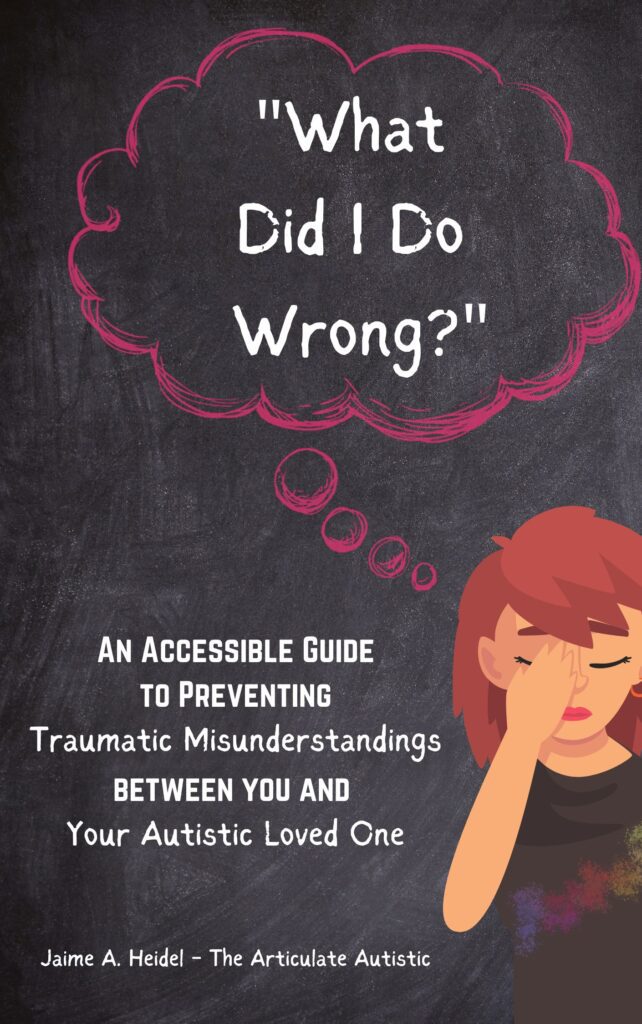
Learn more about how your autistic loved one is perceiving your reactions to them, in detail, by picking up a copy of my book, “What Did I Do Wrong?” An Accessible Guide to Preventing Traumatic Misunderstandings Between You and Your Autistic Loved One