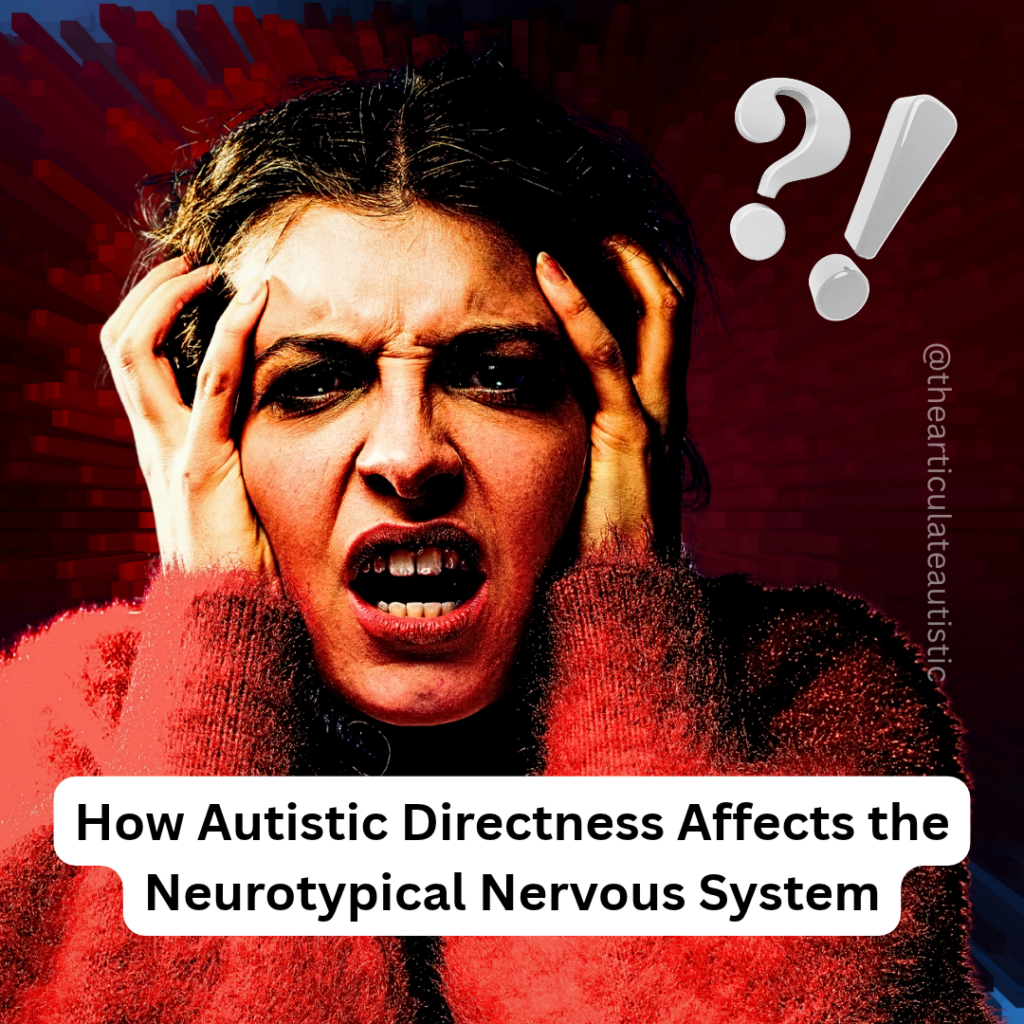
How Autistic Directness Affects the Neurotypical Nervous System
Neurotypical people often trigger autistic people to the point where many of us end up with complex PTSD. A lifetime of confusing and frightening social interactions can also cause chronic anxiety, OCD, depression, and other mental health struggles.
However, autistic people also trigger neurotypical people, and I think it’s just as important for autistic people to learn about neurotypical thoughts, feelings, and reactions as it is the other way around. This is why I’m coming out with a new book in 2027 to explain these critical experiences and possible compromises.
“How am I affecting their nervous system?”
Confusion
When an autistic person walks up to a neurotypical person with no preamble and asks directly for something they want or need, this can confuse the neurotypical person. Per their social structure, if someone is that direct with them, they automatically believe the person is either angry with them or simply can’t stand them.
To the neurotypical ear, directly asking for something feels hostile, causing their nervous system to go into fight-or-flight, making them react defensively.
You may get reactions such as:
“What’s your problem?”
“Can’t you say ‘hi’ first?”
“Why are you demanding things from me? Who do you think you are?”
This, in turn, confuses the autistic person who thought they were merely stating their needs; no offense intended. The reason the disconnect grows as the two volley back and forth is that both the autistic and neurotypical person will be defensive for two different reasons.
The NT person sees the autistic person as rude and is telling them off accordingly, whereas the autistic person is shocked and confused by their reaction, so they desperately try to explain themselves based on their own trauma response!
The biggest problem is that the neurotypical person, based on their social structure, will never tell the autistic person outright that their nervous system has been triggered. One, that’s too direct, and they don’t want to be seen as rude or a burden. Two, that’s far too vulnerable a statement to make if they already don’t trust the person. Three, feelings simply happen, they’re so automatic that the neurotypical person might not be aware that their nervous system has been triggered at all!*
*By the way, this happens with us, too.
Anxiety
Not only are autistic people likely to be direct when asking questions, we’re also direct about everything we say and observe. For example, we may try to be helpful by telling someone they have spinach in their teeth, but because it comes out in a raised and monotone voice, it can come across as judgement, not helpfulness.
The neurotypical person will believe the autistic person is trying to embarrass them, which leads to feelings of anxiety and insecurity.
In and of itself, direct speech can be very triggering for the neurotypical person, regardless of topic. Directness reads as a potential threat, which causes anxiety.
And, as you’ve likely experienced, anxiety can quickly turn into defensiveness and anger.
Uncertainty
Many autistic people recognize patterns and can come up with suggestions to be more efficient and productive in the office and at home. Due to our differences in understanding and relating with the rules of neurotypical social hierarchy, we may think nothing of telling our boss, without preamble, that the way they’ve been doing things is causing backup and lost revenue, while immediately offering solutions.
While the autistic person is beaming inside because they’ve just been helpful and showed that they really care about their job, the boss, who, as a leader, expects everyone to look up to and never question them, they may become uncertain, shook up, and embarrassed; as though their world has suddenly been tilted on its side.
This uncertainty can lead to, you guessed it, anger and hostility, which can, in turn, trigger the autistic person.
Autistic Tone and Delivery Contribute to How Direct Messages Are Received
Have you ever been told to “watch your tone”, but you have no idea what it means because nobody explains beyond that? This has always been one of the hardest ones for me to figure out, too. A monotone delivery with barely any facial expression can come across as “having an attitude”, “thinking we’re too good for others”, or “not knowing our place”.
In addition, “tone” can also mean your energy and the way you carry yourself. For example, if you walk into your boss’s office with stiff shoulders, a wide stance, an aura of urgency about you, and a raised and monotone voice when offering a suggestion, the boss will see this as an aggressive attack, not an attempt to be helpful. And since the advice is coming from a “subordinate”, their brains cannot compute the “impudence”, but when they do recover their senses, watch out for that emotional explosion!
Again, your intention was to be helpful, that’s all, but the boss sees it as anything but. So, when they react with explosive anger, that can be very confusing and frightening for you, triggering your fight-or-flight in return.
The Takeaway
Autistic and neurotypical people struggle to understand one another and often trigger each other. It’s a two-way street. Furthermore, even if you understand these neurotypical reactions intellectually, it can be very hard to “change your behavior” because, through and through, you are acting instinctively according to your brain type!
Just as they are reacting according to theirs.
My goal has always been to help neurotypical people better understand and communicate with their autistic employees and loved ones. My new book will be the reverse of that, where autistic people learn how neurotypical people think and move in the world.
My new book is titled, Why Neurotypical People Are Always Mad at You – An Essential Guide for Autistics, and it will be hitting virtual shelves in 2027.

Coming in 2027