Why Autistic People Explain Themselves So Much During Conflict

If the autistic person in your life tends to explain themselves at length, especially during arguments or tense conversations, it may look like they are trying to dodge responsibility. From the outside, long explanations can seem like excuses, backpedaling, or an attempt to redirect attention away from the hurt they caused.
But that is often not what is happening at all.
For many autistic people, explaining is not a trick. It is one of the main ways we try to repair a situation, show empathy, and restore balance after something has gone wrong.
Why Explaining Feels Like the Right Response
Some autistic people grow up believing that if they can just make their meaning clear enough, the other person will stop being angry or hurt. In that framework, explanation feels caring. It feels responsible. It feels like the most logical and compassionate thing to do.
If I can show you what I meant, maybe you will understand that I was not trying to be cruel. If you understand that, maybe the emotional intensity will come down. If the intensity comes down, maybe we can get back to equilibrium. For many autistic minds, that sequence feels natural.
That is part of why explaining can happen so quickly and so intensely. We are not always trying to erase the impact. We may be trying to help you see the internal logic behind what happened because, to us, understanding usually lowers distress.
Logic as a Survival Tool
For many autistic people, logic is not just a preference. It is our primary operating system. We rely on explanation, patterns, and cause-and-effect reasoning to make sense of a world that often feels unpredictable and overwhelming.
That means when tension rises, our brains may automatically reach for explanation the same way another person might reach for a comforting tone of voice or physical affection. We are moving toward the tool that has historically helped us regulate.
The problem is that this autistic strategy often collides hard with neurotypical emotional processing.
When the Other Person Is No Longer in a Logical State
Many autistic people do not realize until relatively late in life that emotions can completely block logic for some neurotypical people. We may assume that if we calmly explain our thought process, the other person will feel better. After all, that is often what would help us.
But when a neurotypical person is flooded with hurt, anger, or frustration, they may not be able to process explanations as empathy. They may hear it as minimizing, deflecting, or trying to talk them out of their feelings. So the autistic person thinks, “I am trying to show you what happened and why.” The neurotypical person hears, “I am trying to prove I should not be held accountable.”
So the autistic person thinks, “I am trying to show you what happened and why.” The neurotypical person hears, “I am trying to prove I should not be held accountable.”
Jaime A. Heidel
That mismatch can turn one painful moment into a much bigger rupture.
Why It Can Look So Defensive
Explaining often involves backtracking. We revisit the sequence of events, clarify words, describe intentions, and try to connect dots. To someone who is already upset, this can sound like a courtroom defense.
Yet for the autistic person, it may not feel defensive at all. It may feel like the most sincere way to say, “Please see that I was not trying to hurt you. If you can understand what happened, maybe we can stop hurting each other.”
A Long Fuse, Then a Blowout
Some autistic people describe themselves as having a very long fuse. They can tolerate confusion, stress, and emotional pressure for a long time. But when that fuse finally burns down, the reaction can be explosive. At that point, logic can disappear for them too, especially if they are heading toward a meltdown.
That is an important reminder that autistic people are not emotionless or purely rational. Many of us are deeply emotional. We just tend to rely on logic until our nervous system can no longer hold the load.
So if an autistic person explains and explains and explains, that may be their attempt to prevent the conversation from crossing the line into total emotional chaos.
What Helps in Real Life
If you are on the receiving end of these explanations, it can help to separate intent from timing. The explanation may be sincere, but the timing may still be bad. In the middle of fresh hurt, you may need acknowledgement before you can absorb context.
That is why conversations often go better when both people learn a shared order of operations. For example: first acknowledge the hurt, then explain intentions, then talk about how to prevent the same problem next time.
The autistic person may also need explicit feedback such as, “I am not ready for the explanation yet. First I need you to understand that I am hurt.” That kind of direct guidance can be far more effective than hoping that your autistic loved one will intuit the right sequence.
The Takeaway
When autistic people explain themselves at length in conflict, it often looks like avoidance. In many cases, though, it is actually an attempt at empathy through understanding. They are trying to calm the situation in the way that would calm them.
They are trying to calm the situation in the way that would calm them.
Jaime A. Heidel
That does not mean the explanation will always land well. But once both people understand what function it serves, it becomes easier to create a better pattern: one where feelings are acknowledged, context is shared at the right time, and neither person has to keep guessing what the other one means.
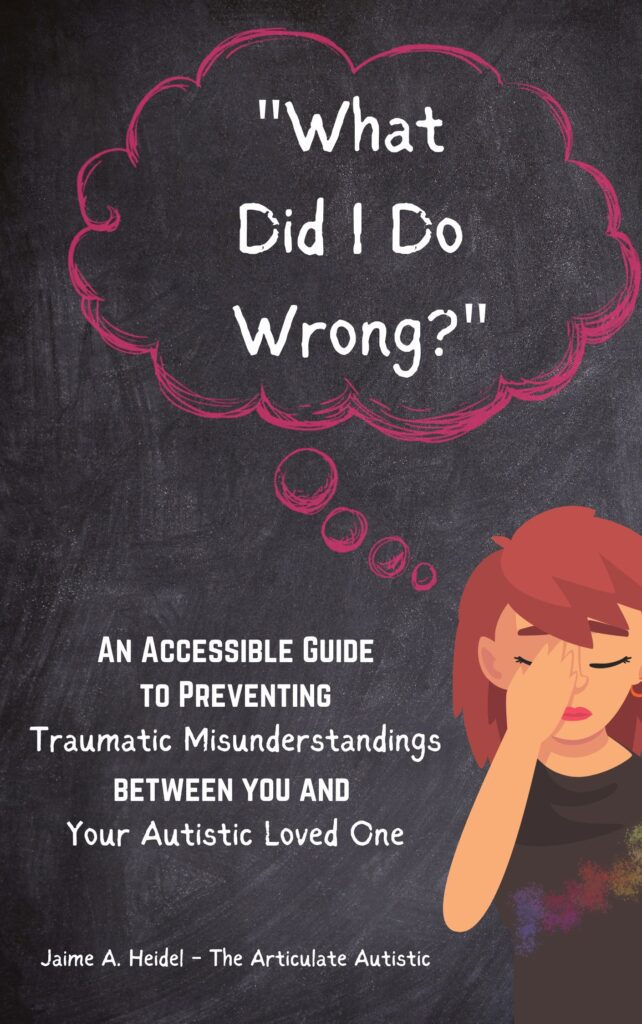
Learn more about how autistic people think and process the world by picking up a copy of my book, “What Did I Do Wrong” – An Accessible Guide to Preventing Traumatic Misunderstandings Between You and Your Autistic Loved One.