Teach the Way They Learn – A Guide for Managers of Autistic Employees

When your autistic employee tells you, over and over again, that they don’t understand what you’re teaching, you may be tempted to think they’re being difficult or arguing with you.
Neither is the case.
Things Your Autistic Employees Do That Appear Difficult or Arguing
- Asking frequent questions about topics you’ve already covered.
- Using statements such as “Yes, but…”
- Telling you they understand the first half of what you said, but not the rest
- Getting visibility agitated at their inability to pick up on what you’re teaching
When these moments happen, your employees have no intention of being difficult or arguing with you; they are desperately trying to understand.
For example, if your employee interrupts you during training or says “Yes, but…”, it may seem like arguing. Still, it’s the autistic employee looking for more context and seeking reassurance that you’re both on the same page to avoid having to do the project over in the future.
Autistic People Are Bottom-Up Thinkers
While your neurotypical employees think from the top down, starting with the whole picture and then drilling down into the details later, your autistic employee is the opposite.
Autistic brains start with the details first, and only when they have all of those details can they form a complete mental picture of what’s expected of them.
This is why they interrupt, double-check or even triple-check, ask questions you’ve already answered, and become agitated. This is not rudeness; their nervous system is overloaded from trying to translate your neurotypical way of teaching into their neurodivergent way of learning.
Their nervous system is overloaded from trying to translate your neurotypical way of teaching into their neurodivergent way of learning.
Jaime A. Heidel
For them, it’s like trying to make sense of a language they either don’t speak at all or only speak casually. They’re not fluent in neurotypical just like you’re not fluent in autistic.
Teach the Way They Learn
Providing plenty of context, details, and background information. Answer all questions, and allow your autistic employee to write things down, as well.
Even if it seems easy to you, and they break out a pen and paper to take notes, they’re not being sarcastic. Their only goal is to understand what you’re asking for and get it right the first time.
Furthermore, this isn’t a matter of confidence as many managers believe. It’s a matter of a brain that works and learns differently.
Follow Their Tips on How to Teach Them
Although it may seem contrary to the way you run your business, due to social hierarchy, autistic people know best how they learn and what they need.
Therefore, following their lead without treating them as if they are trying to take control from you can create a better understanding and more seamless conversations.
For example:
Let’s say you manage an autistic nurse, and the charting system recently changed. There hasn’t been any training on it; the medical staff is simply expected to take what they’ve learned from the old system and apply it to the new.
While the autistic employee may be able to make some of those connections, they will still have questions, and oftentimes, managers will respond (with growing annoyance each time) with the original instructions front to back.
This can be very confusing and frustrating for the autistic person who just needs one more detail to fill in the blanks and know what to do.
So, if they say something like, “No, I don’t need all that information. I know those parts; just tell me what you want me to put in this box.” They are not ordering you around or challenging you; they are trying to get that last, precious, elusive clue that will finally make everything click.
They are not ordering you around or challenging you; they are trying to get that last, precious, elusive clue that will finally make everything click.
Jaime A. Heidel
Answer the question directly and with an even tone.
“Put this information in this box.”
Clean and simple.
The Takeaway
Teaching the way your autistic employee learns, allowing them to lead their learning process, and avoiding interpreting their behavior as rude or insubordinate can go a long way in helping you both work better together and establish a lasting trust.
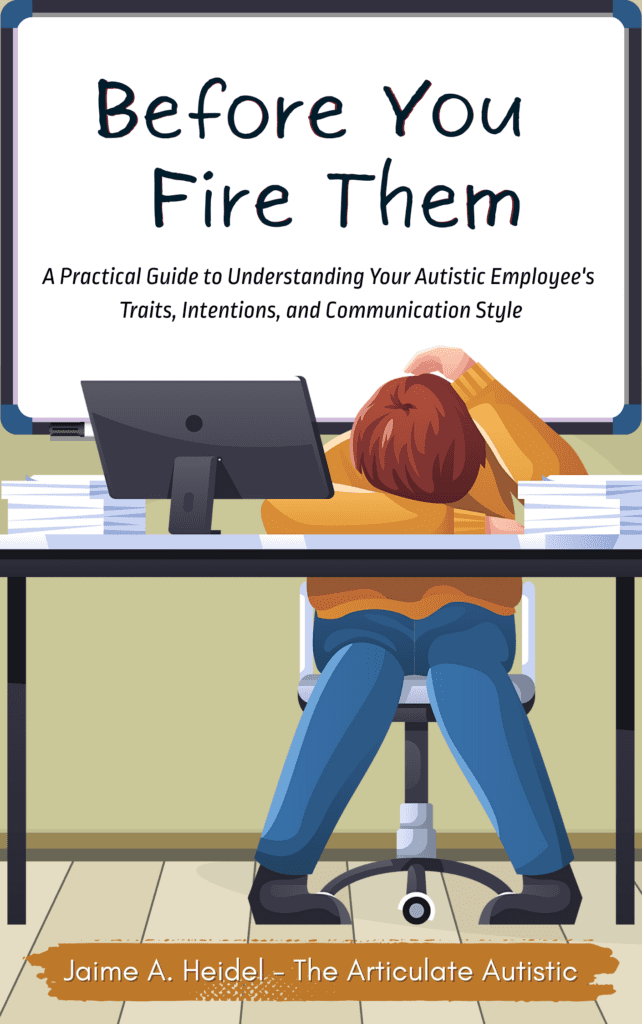
Better understand your autistic employee’s traits, intentions, and communication style by picking up a copy of my book, Before You Fire Them.