10 Common Reasons Managers Get Annoyed With Their Autistic Employees

I asked the autistic community on TikTok; “What do you get in trouble for most at work?”
Here are their responses:
- Working too quickly or efficiently
When autistic employees work too quickly or efficiently, it makes their neurotypical coworkers look as though they are not doing enough, and they resent it.
- Asking clarifying questions
Asking clarifying questions is often received by neurotypical managers as a challenge to their authority, or an attempt to get out of doing a task.
- Misunderstanding instructions
If a manager gives instructions to their autistic employees the same way they teach their neurotypical employees, something is going to get lost in translation.
Autistic people are bottom-up thinkers. Therefore, they need detailed, step-by-step instructions to understand what’s expected of them.
- Finding solutions for flaws in the existing system
An autistic employee who finds flaws in the existing system often points them out with enthusiasm and quickly offers solutions unprompted.
This often comes across as “kissing butt”, thinking they are better than everyone else, thinking they’re smarter than the higher-ups, or secretly angling for a raise.
- Being honest
When an autistic employee is asked a question, they’ll give an honest answer, even if, secretly, that wasn’t what the person wanted.

- Having a “tone” when speaking to others
Many autistic people are told they have a “tone” in their voice that sounds offensive to others, or that their overall demeanor puts people on the defensive.
- Having a flat facial expression
Autistic people are often seen as rude, standoffish, and “above it all” because their natural resting facial expression is blank.
- Speaking in a monotone voice
Autistic people are also seen as rude, standoffish, and “above it all” because they speak in a monotone voice that makes others unable to read them.
- Revealing “open secrets”
If the office is discussing “open secrets”, such as the boss drinks at his desk, or one coworker is having an affair with another, the autistic employee will think nothing of talking about it in front of management or even the subject of the rumor!
- Not socializing with coworkers
Autistic people who spend their breaks and mealtimes alone are often seen as stuck up, better than others, or just plain rude.
What if I told you none of this is on purpose, none of this is to undermine management, and there’s no intent to embarrass or one-up coworkers?
It’s true.
If your autistic employee is doing any of these things, it’s a result of different brain wiring, not malice.
Because of these frequent misunderstandings, autistic employees are often suddenly dismissed from a conversation, told off, or ostracized by others, and they genuinely have no idea why.
This continually shocks their nervous systems and causes them to become more dysregulated by the confusion and harsh treatment, which, in turn, makes them more of a target for it.
If you’re a manager who works with autistic employees, I highly recommend my book, Before You Fire Them – A Practical Guide to Understanding Your Autistic Employee’s Traits, Intentions, and Communication Style.
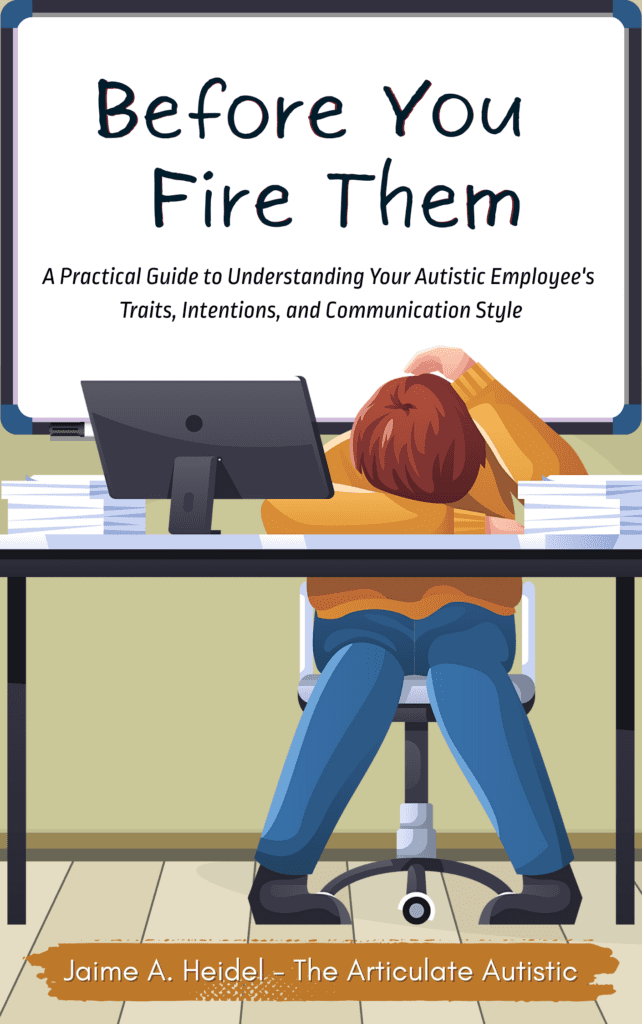
This guide is short, easy to browse through, and will help improve your communication with your autistic employee on day 1!
Don’t fire your autistic employees; learn how to communicate and work with them instead.