5 Things Autistic People Do During the Holidays That Are Perceived as Rude
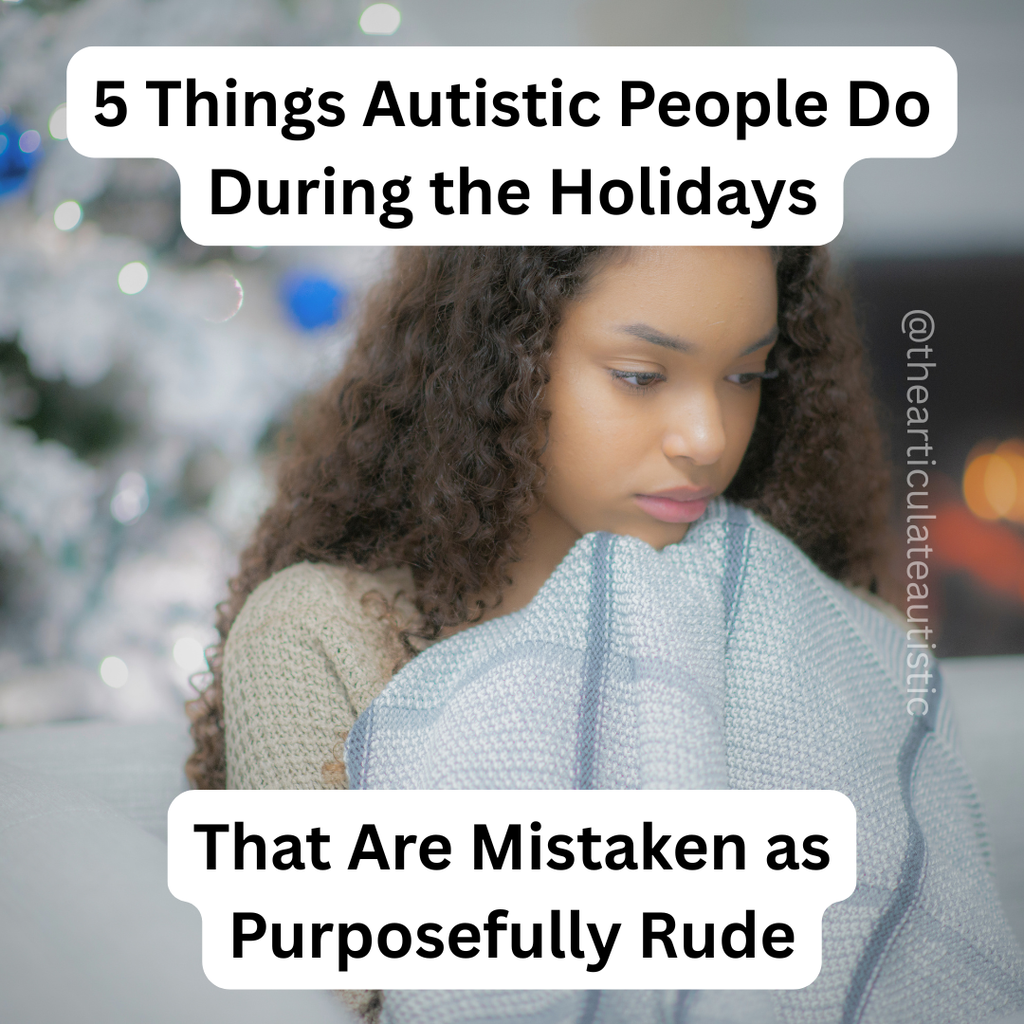
While the holidays can be the most wonderful time of year for neurotypical people, they can be the opposite for your autistic loved one.
This is because neurotypical and autistic people view this time of year through completely different lenses.
Also, autistic people are often reprimanded for how they act or don’t act, which turns an already uncomfortable holiday experience into a miserable one.
Not only is there a huge change in routine for the autistic person, which can be very dysregulating, there are different social expectations during the holidays that aren’t there in everyday situations.
Let’s take a look at 5 things autistic people do during the holidays that are often perceived as rude.
- Responding to gifts differently than expected
When a neurotypical person receives a gift, they usually express happiness and gratitude through their body language and facial expressions, as well as saying an enthusiastic ‘thank you’.
When an autistic person receives a gift, they may open it, mutter a ‘thank you’ and be done with it. You may even notice stiff and rigid body language and a flat affect.
This doesn’t mean they don’t like or appreciate the gift, their emotions just don’t show in their body language or face. Also, as I discuss in more detail below, that rigid body language and lukewarm response may be due to a fear of being perceived.
While a neurotypical person automatically knows that even if they don’t like the gift or can’t use it to say ‘thank you’ and act as though it’s the best present ever, an autistic person may not realize this.
Furthermore, many autistic people have a very difficult time being perceived. If someone (or multiple someones) are watching them open the present, they may feel paralyzed by anxiety, go rigid, and lose their words.
Personally, I used to feel betrayed by gifts. Every holiday reminded me that my family did not know me and hadn’t listened to anything I said throughout the year.
I got a wool sweater once, and I’m sensitive to wool and I said so out loud, I received strong-smelling lotions that I couldn’t wear due to my allergies (which they knew I had), food that I couldn’t eat (gluten intolerance), and even earrings, though I don’t have pierced ears.
One holiday, I received a purse that I couldn’t use because, after an upper back injury, I could only use mini backpacks (which, again, I’d told them), and that was the last straw for me. I felt so hurt and betrayed and almost believed they had to be doing it on purpose at that point.
Not only that, but I thought it was logical to tell them when I couldn’t use the things they got for me because I didn’t want them to give me those same things or something like them again next year!
Not only that, but I thought it was logical to tell them when I couldn’t use the things they got for me because I didn’t want them to give me those same things or something like them again next year!
Jaime A. Heidel – The Articulate Autistic
They never gave me a holiday present after the incident with the purse, and I was very grateful because it took so much pressure off of me.
What I’ve since learned is that neurotypical people don’t see an autistic person as just rejecting the gift, they see it as a rejection of them, which is why other neurotypical people act ecstatic even over gifts they hate.
You can circumvent most of this by avoiding buying presents just because they are in the right age group or something “a boy would like” or something “a girl would like” or because it’s a current trend.
Listen to your autistic loved one throughout the year and choose gifts you know they will like and use
Listen to your autistic loved one throughout the year and choose gifts you know they will like and use.
Jaime A. Heidel – The Articulate Autistic
You can also ask the autistic person what they want or need, which takes the guesswork out of everything!
- Being unaware you need help with preparations
If you are putting up holiday decorations, making a meal, wrapping presents, etc. the day before, and your autistic loved one is with you, you may automatically think they are selfish and lazy because you’re doing all this hard work, and yet they’re not offering to help.
This isn’t selfishness or laziness. When an autistic person sees you doing something, they’ll usually leave you to it, even if you are giving subtle or even not-so-subtle hints that you need help. They’re not ignoring you, they’re not picking up on your hints!
If you need help with holiday prep from an autistic person, ask directly and assign them to a task that matches their abilities.
- Eating a different meal from everyone else
Many neurotypical people feel that when someone brings their own food to a party that they either don’t like the host’s cooking or they don’t trust them. Again, to the neurotypical person, this doesn’t only feel like a rejection of the food (or an inability to eat the food), it feels like rejection of the one who prepared it.
Autistic people often bring their own food to gatherings due to allergies, need for familiarity, and sensory differences. Eating this same food helps them feel calmer and more regulated in the chaos of the party atmosphere.
It also prevents them from pushing food they can’t eat around their plate while still going hungry. And when I say can’t eat, I mean can’t eat. It’s not a preference. Certain tastes and textures are completely intolerable to autistic people due to sensory differences.
- Retreating from the main party often
You may notice that your autistic loved one often retreats to a quiet area, such as the bathroom, frequently during the party. Or they may exclusively focus on the pets or children during the gathering.
This doesn’t mean the autistic person doesn’t care about you or what’s going on around them, rather, they’re overwhelmed and need frequent breaks to regulate their nervous system. This way, they can stay centered, grounded, and present throughout the celebration.
- Canceling last-minute
Don’t be surprised if you get a last-minute call from your autistic loved one saying they won’t be able to make the gathering.
They will likely feel terrible and ashamed about it, but their sensory overload and emotional overwhelm may be too high for them to safely attend your party.
They don’t want to derail the festivities, and they don’t want to have a meltdown or shutdown that appears as though they’re seeking attention.
They’d rather dodge the party entirely than go to it feeling agitated and unintentionally snapping at you or the guests.
The Takeaway
Your autistic loved one is not trying to be rude during the holidays; rather, they’re operating according to their unique brain wiring. Please be understanding, forgiving, and patient. Their actions don’t come from a place of malice.
And if you need something, be specific.
They are not rejecting you, their nervous system is rejecting the environment, and that’s not something they can control, especially if they’re younger and haven’t learned those unspoken social rules yet.
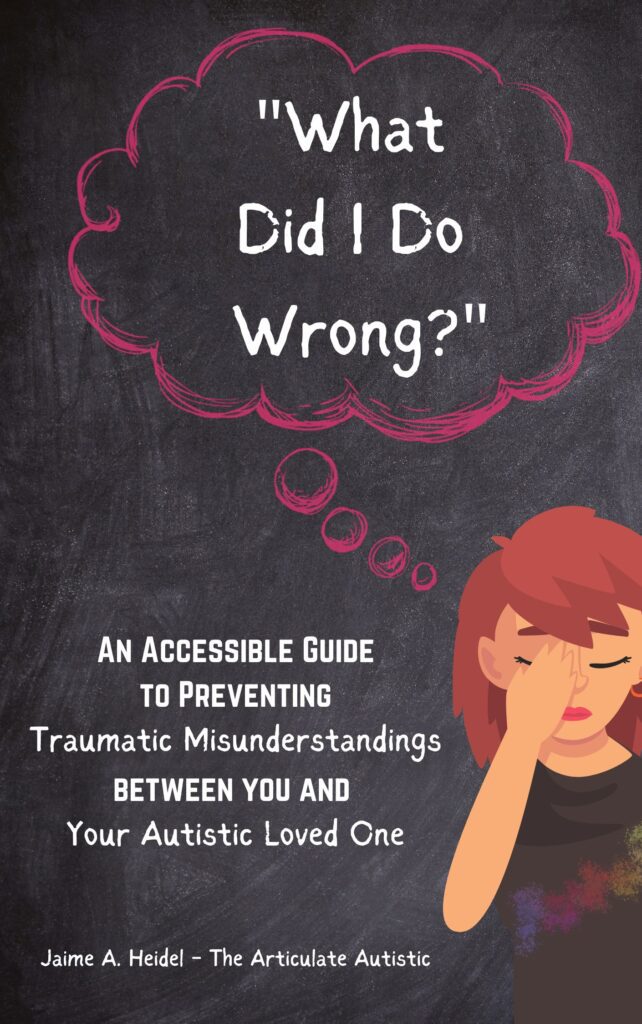
Learn more about how your autistic loved one views, understands, and interacts with the world by picking up a copy of my book, “What Did I Do Wrong?” – An Accessible Guide to Preventing Traumatic Misunderstandings Between You and Your Autistic Loved One.