8 Reasons Autistic People Are Fired from Jobs

As soon as an autistic employee walks through the door for their first day on the job, someone will clock that they’re different.
According to the neurotypical social code, the autistic person will be assessed, ranked, and quickly placed at the bottom of the social ladder because they’re different; even high-masking autistic people will eventually be found out and ranked.
Within a few weeks, you’ll innocently violate so many neurotypical social rules that you’ll be labeled a problem and may soon become the target of workplace bullies.
Scary? Yes. True? Also yes.
So, why does this happen? What is it about autistic people that makes it almost impossible to work in the neurotypical world?
First, let’s look at what’s not causing the problem. Your experience, your education, your expertise, and your intelligence are not in question.
You’re full of ideas, you’re excited to get started, and you focus heavily on your work, so you can turn it in as accurately and efficiently as possible.
There’s nothing wrong with that…except there is.
Let’s take a look at 8 reasons autistic people are dismissed from their jobs.
- Asking questions
If you’re autistic, the only function of a question is to get an answer. Unfortunately, for neurotypical people, questions are rarely received this way.
For your neurotypical manager, your questions read as a challenge to their authority and intelligence. It’s as though you’re telling them that they either didn’t train you properly or you’re “slow”.
Autistic people need answers because we are bottom-up thinkers who require more details to get the full picture of what is expected of us.
The sad thing is, even if your boss asks if you have any questions, they expect you to say, “No” or they’ll turn it around on you. “You should know that by now. Didn’t you read your training manual? Why are you asking a day-one question?”
It’s not your fault. You’re asking in good faith, but your questions are being received as the opposite of what you intend.
- Making suggestions
Many autistic people on the job find their natural pattern recognition abilities go to work immediately while they are doing their job. This means we often spot anything that’s backing up workflow. We can easily see where the company is losing time or money and come up with creative solutions immediately.
However, when we openly offer to implement those solutions, asking for nothing in return, we are not met with gratitude and a pat on the back. Instead, we’re looked at as though we just walked into the room nude.
You have an earnest desire to help, but your neurotypical managers view your suggestions (especially as someone at the bottom rung of the professional ladder) as inconceivable and insulting. They can’t believe you would have the gall to point anything out that might be gumming up the works.
Neurotypical people already know they are expected to keep their heads down, go with the flow, and do whatever is asked of them whether they agree with it or not because that’s what the manager told them to do.*
When you don’t automatically know and go along with this, the behavior immediately signals you out as “someone to keep an eye on”. You may even receive more work and more criticism as they attempt to “put you back in your place”.
When even this goes over your head, the only response they have to your “lack of contrition” is to bully you out of the job or outright fire you.
* Is every single manager on the planet like this? No. But unless they are open-minded, genuinely welcome feedback, and are at least somewhat familiar with neurodivergence, you’re better off erring on the side of caution by not offering solutions, no matter how much easier everything would be.
- Avoiding social events
This is a big reason autistic people get fired. Declining to attend work social events is considered a social crime in the eyes of many neurotypical people.
If you can’t make it to one because you have a migraine or you can’t get a sitter, that’s one thing, but if you decline any more than once (twice if you’re lucky), you are automatically filed into categories such “suspicious”, “not being a team player”, and “stuck-up”.
And, since you’re a literal thinker, it really doesn’t help that your manager couches these invitations as optional.
“Oh, if you’re not doing anything tonight, a bunch of us are going to happy hour at Jake’s.” “If you’re free, we’re all going to meet for lunch tomorrow at the Italian restaurant down the street.” “We’re planning a 30th surprise birthday party for Becky in IT. You should come!”
“If you’re not doing anything tonight.”
“If you’re free.”
“You should come!”
They all mean only one thing: You are expected to be there.
- Inability to understand social cues
Missing neurotypical social cues can get autistic people fired because their neurotypical boss and coworkers think they’re ignoring the cue instead of simply not seeing it.
While autistic people largely rely on direct speech to communicate, neurotypical people rely on vocal tone, facial expression, environmental context, and body language to get their “hidden meaning” across when they speak.
When you only respond literally to what they say, you’ll either seem “off” to them or like a purposeful jerk. They’ll start to think that you think you’re above everyone else because you “chose” not to participate when, in reality, you had no clue.
- Misunderstanding instructions
Most of us autistic folks are literal thinkers. If someone tells us to do something, we’ll do it exactly to the letter. If there are any hidden cues, instructions, or double meanings behind the words, they will not register.
So, when we turn in an assignment that’s “all wrong” even though we followed the instructions as we understood them, they’ll view this as lack of intelligence, laziness, or the dreaded malicious compliance.
I use the “do the dishes” example a lot.
You’re working in fast food, and your employer tells you to go in the back and do the dishes. You do just that. You wash the dishes, put them on the drying rack, wipe your hands, and you’re done…right?
Wrong.
Your boss comes in an hour later to check your work and asks, “Why didn’t you take care of the dishes?”
Puzzled, you point to the dishes drying on the rack.
Your boss gives you a dirty look as though you’re “talking back” to them, and says, “Obviously, I meant for you to do the dishes, dry them, put them away, clean any extra bits of food out of the sink, hose down the sink, and mop the floor after you’re done with all that.”
You did exactly what was asked, but there were apparently hidden instructions behind the verbal ones that you, understandably, didn’t pick up on!
- Overdoing projects
Another thing that can get an autistic person canned from a job is, believe it or not, overdoing projects.
For example, if your boss asks you for a 5-page report, and you present them with a 15-page report complete with graphs and pie charts, they won’t take it as showing initiative, they’ll think you’re a show-off, a kiss-up, or both!*
Or, even worse, they’ll think you’re showing off and angling for their job.
* I will say one thing in defense of the neurotypical person who received all that extra work. They may not be able to find time to read and go through it all because they allotted only 5 pages of time into their schedule, which, understandably, can be an inconvenience.
- Finishing projects faster than others
When our monotropic brains get focused on something, we just get into it and do it.
Due to poor interoception during hyperfocus, we may forget to use the bathroom, take a break, or have lunch, and do little else other than breathe, blink, and swallow until the project is complete.
As a result, we often finish our work much faster than our coworkers, which, in turn, makes them think we’re trying to make them look bad!
- Difference in perception of social hierarchy
At the heart of all of this is either the autistic lack of awareness of social hierarchy or a difference in their perception and reaction to it.
When I was younger and in the working world, I had never even heard of “social hierarchy”. I just treated and talked to everyone the same way.
It took me a long time to learn that neurotypical people have specific social ranks depending on age, social status, job title, and tenure, and everyone expects to be addressed differently according to those ranks.
So, when an autistic person in an entry-level position makes a suggestion to someone higher up on the professional ladder, they’re viewed like an ant daring to pick a fight with an elephant.
It’s incredibly insulting to them because they automatically follow and defer to this invisible social hierarchy! Why don’t you??
The Takeaway
Again, not every neurotypical person in every job will respond negatively to your autistic traits, but, due to lack of understanding and education about how autistic people think, communicate, and navigate in the workplace, it’s all too common.
I didn’t write this article to scare you, just to give you a cold, hard look at what neurotypical people see when they work with you. I want to give you an understanding of what’s happening behind the scenes to help you circumvent some of these conflicts.
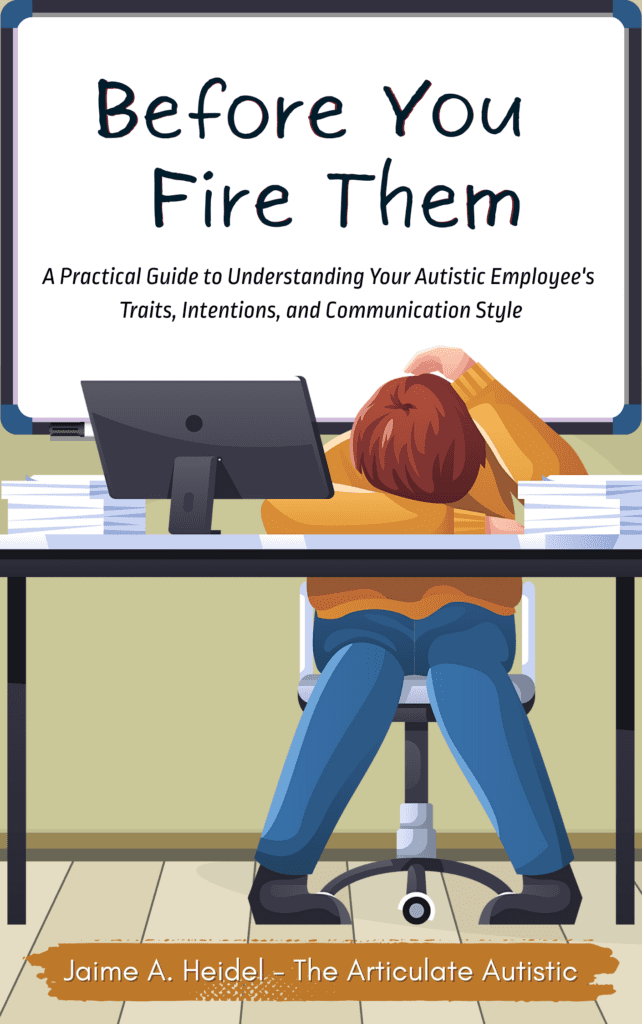
If you want a more comprehensive look at how managers misunderstand and misinterpret autistic traits, I highly recommend my book, Before You Fire Them – An Accessible Guide to Understanding Your Autistic Employee’s Traits, Intentions, and Communication Style.
I originally wrote it for neurotypical managers, but this knowledge can also give you, the autistic person, the understanding you need to have an edge in your workplace environment.