5 Signs Your Autistic Employee Is Afraid of You

If you have one or more autistic employees, you may be confused and frustrated by their traits and communication style. Their behavior seems to flash like neon signs pointing to:
- Deception
- Insubordination
- Purposeful Rudeness
- Being Dramatic
But what if I told you those behaviors, the ones you’d reprimand or fire a neurotypical employee over, are autistic signs of fear?
Let’s take a closer look at some of the signs your autistic employee may be afraid of you:
1. They avoid conversations with you whenever possible.
You think: “They’re hiding something, they’re guilty of something, or they’re being rude and insubordinate.”
They think: “If I just make myself scarce and stay out of her way, she won’t keep getting angry at me.”
2. They stop talking and stiffen up as soon as you appear.
You think: “They’re up to something. I’ll watch them closely today and see what they’re hiding from me.”
They think: “Oh, no. He just walked in. Did he hear me humming? Did he see me flapping? Is he going to ask me to work on a project, because last time he got so mad when I asked follow-up questions, he refused to answer them, and I messed it all up? Wait…why is he just watching me from the corner of the room now? Great, I forgot how to hold a pen!*
* Autistic people often have difficulty starting or continuing a task if they know they’re being perceived.
3. They avoid eye contact, fidget, speak softly, and only answer “yes” or “no” questions without elaborating*
* These traits are also natural to autistic people who are not frightened, but it is often misunderstood, no matter the context.
You think: “They’re so evasive! What are they hiding from me? Can’t they have enough respect to look at me when I’m talking?”
They think: “She’s looking right at me, but I can’t meet her eyes; it’s too painful. I’m fidgeting to comfort myself. Maybe if I also speak softly, she won’t be as offended by my words as she often seems to be?”
4. They ask your permission before doing anything that isn’t explicitly in their job description.
You think: “Goodness. I’m not a teacher. They don’t have to ask me permission to do every little thing. Maybe show some initiative and stop expecting so much hand-holding? This is the real world!”
They think: “I learned my lesson when I went to another department last week to see if they needed help. I didn’t realize I was supposed to ask my own team members first if they needed help before moving on to another department. (I guess our ‘team’ consists of only the people in Cluster A? I didn’t know that.) My boss said I needed to show some initiative, and I thought that’s what I’d done. From now on, though, I’m going to specifically ask so I don’t get into trouble again.”
5. They’re frequently jumpy, tearful, or defensive around you.
You think: “What is wrong with my employee? Do they need help with their mental health? Or are they just like this around me? I’ve seen them talking and laughing with their co-workers. What’s going on here?”
They think: “Oh, boy. Here she comes. Is she going to accuse me of doing something, not doing something, missing something, or not paying attention? She always seems angry with me, no matter what I say or do.”
Workplace Trauma
Many autistic people have experienced workplace trauma at multiple jobs. They come to you not as a calm, regulated person with a can-do attitude, but as a capable, sensitive, and intelligent person who has been yelled at, demoted, accused of confusing things, or outright fired more times than they can count.
Many autistic people have experienced workplace trauma at multiple jobs. They come to you not as a calm, regulated person with a can-do attitude, but as a capable, sensitive, and intelligent person who has been yelled at, demoted, accused of confusing things, or outright fired more times than they can count.
Jaime A. Heidel
And they are never, ever told what they did wrong. It’s always something generic like, “You’re just not a good culture fit”.
Since we never know what prompted the firing, we never know when the next shoe is going to drop and hit us right in the head.

Furthermore, our natural autistic traits, intentions, and communication style are sometimes so vastly misinterpreted that it leads to displays of anger and retaliation from managers and co-workers that most neurotypical people never experience.
And that causes trauma.
So, here they are, going into a new position, and wondering the whole time when, where, and how they’ll be accused of doing something they had no intention of doing and being fired again.
Two Reasons for Fear
Past Trauma
Your autistic employee might not be afraid of you, per se, but may recognize patterns that show them they’re going to face the same problems they did in other jobs; they’re just bracing for it.
This can cause a high startle reflex, defensiveness, emotional explanations that border on desperation, and the sincere belief that any time you ask to speak with them privately, it’s because you’re going to fire them on the spot.
Present Trauma
Your autistic employee may be afraid of you because of how you both clash with and misunderstand each other. Your reactions make them unsure of how to be around you. Getting easily frustrated with them, snapping at them, talking down to them, or unintentionally gaslighting them causes trauma.
What is ‘unintentional gaslighting’?
A good example of unintentional gaslighting would be, you gave your autistic employee instructions, they followed those instructions literally, they turn the project in, and you’re flabbergasted that they didn’t ‘read between the lines’ of what you really wanted because it was ‘so obvious’.
They explain, in detail, how they followed your instructions to the letter, but it’s then, and only then, that you finally reveal that’s not what you really ‘meant’.
This causes the autistic person’s brain to spiral because we are literal thinkers and don’t always catch what’s ‘obvious’ to a neurotypical person. Going through this frequently can make us feel stuck; damned if we do, damned if we don’t.
So, we freeze, fight (defensiveness), take flight, or fawn (masking) because the directions we’re given never feel clear enough for us to act on them. This means, as a manager, you’re going to get a lot of ‘winging it’ and become even more frustrated while your autistic employee dangles on a string, just waiting to be ‘let go’.
The Takeaway
Being autistic in the corporate world is stressful, even if we don’t feel afraid of our bosses or shunned by our co-workers.
A typical 9-to-5 office job comes not only with fluorescent lights, loud sounds frequently changing pitch and intensity, intense smells that mingle in an unfortunate way (coffee, perfume, body odor, the fish someone insists on cooking in the microwave, etc.), and constant interruptions and changes; it also frequently comes standard with a boss who misinterprets you, and co-workers who look at you like you’re one of the sources of the aforementioned unfortunate smells.
It’s a lot.
However, it doesn’t have to be. You can help your autistic employee feel safer and more secure at work. A good first step is to treat accommodations as needs and allow their use whenever necessary.
Accommodations such as designated quiet workspaces, the ability to use noise-canceling headphones or Loop earplugs to manage auditory input, or a pair of glasses that reduce computer glare can help the autistic employee feel physically more regulated and safe.
Other helpful accommodations may include the open use of fidgets, allowing your autistic employees to take frequent breaks, giving them instructions in writing, reducing interruptions, and allowing them to work from home when possible.
If your autistic employee is afraid of you, you might not have been aware of it until now because you were mistaking signs of fear for something else.
If your autistic employee is afraid of you, you might not have been aware of it until now because you were mistaking signs of fear for something else.
Jaime A. Heidel
Allowing accommodations is wonderful, but creating a psychologically safe workplace also means educating yourself about how the autistic brain works and how to adjust your perceptions and expectations so they’re not afraid, and you’re not frustrated.
Better understand your autistic employee’s traits, intentions, and communication style by picking up a copy of my book, Before You Fire Them. In this short, easy-to-navigate guide, you’ll learn where the cracks in the foundation are, how they start, and how to mend them before anything else breaks… including your autistic employee.
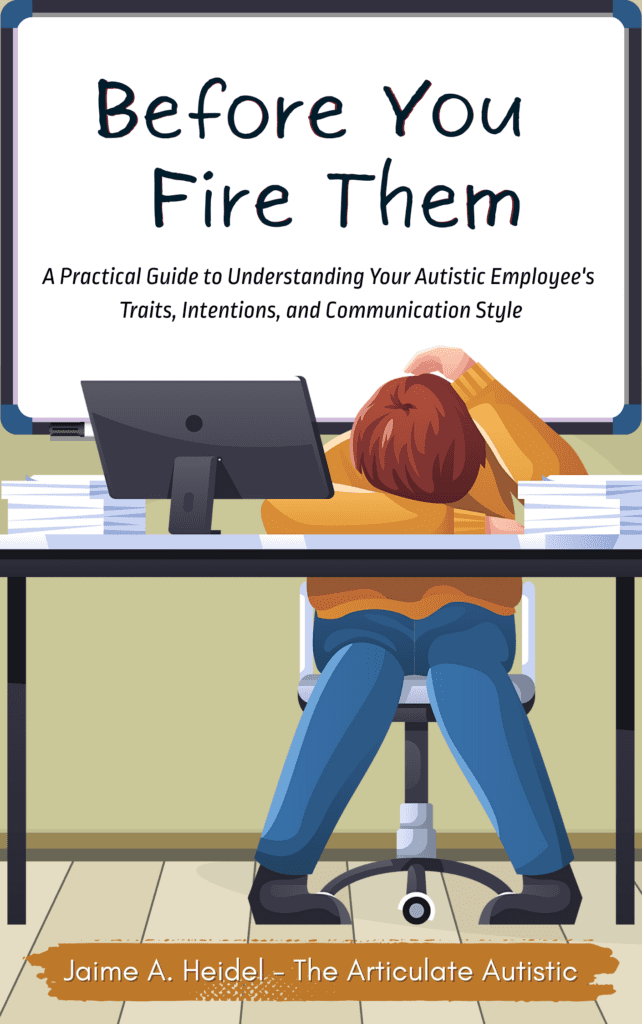
Before You Fire Them can help you boost morale, increase productivity, and enjoy a better working relationship with all of your employees. After all, if you’re more relaxed and your autistic employees are less afraid, you’ll find everyone in the office benefiting from this peaceful, more comfortable working environment.
Pick up your copy of Before You Fire Them online, wherever books are sold!






Excellent article. I think a lot of what you mentioned can be applied outside the workplace as well.