Why Your Autistic Child May Laugh When You Are Angry
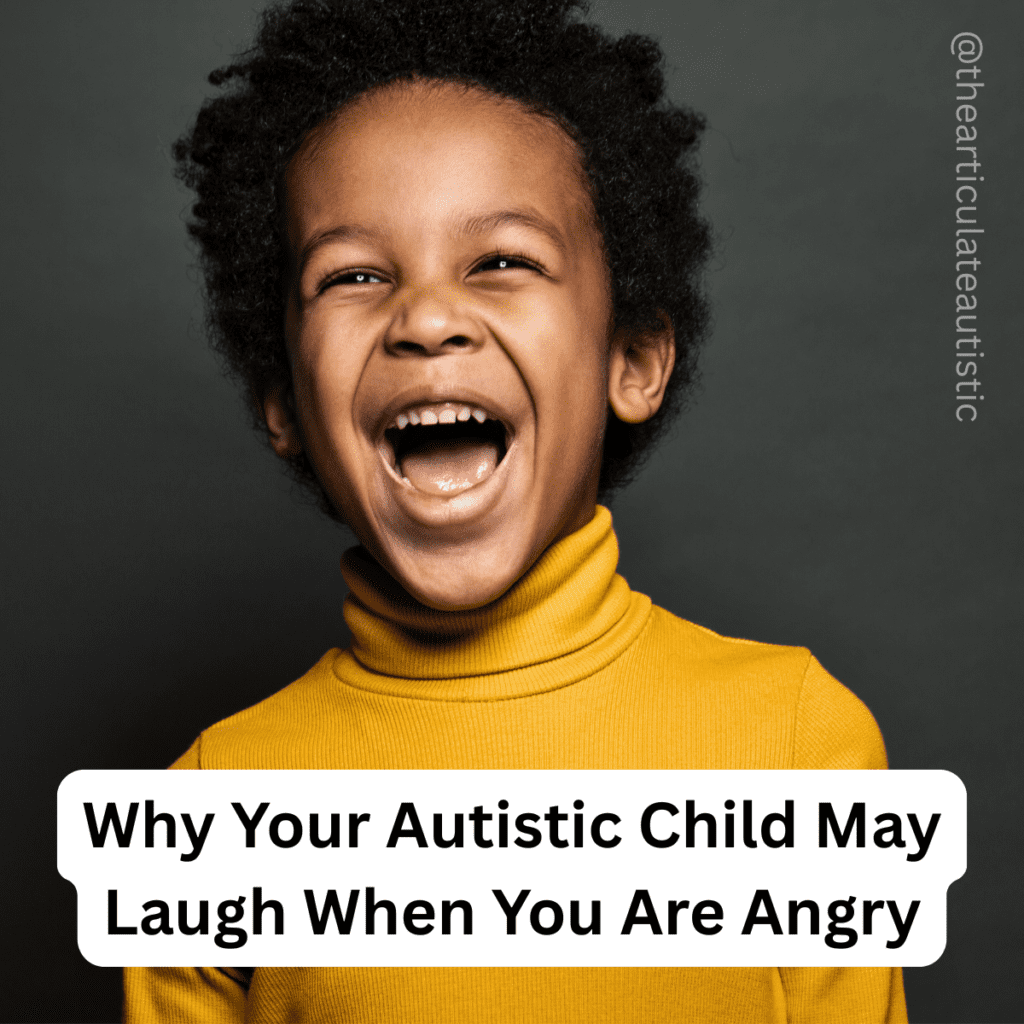
If you are the parent of an autistic child, you may have had moments when your child laughed or smiled while you were furious. In those seconds, it can feel like outright defiance or mockery. You may have grounded them, yelled, or added consequences on top of whatever started the conflict in the first place.
There is always a possibility that a child of any neurotype is being intentionally rude. More often, though, especially with autistic children, something entirely different is happening.
When I was a child, teenager, and young adult, I frequently got into serious trouble for what adults called inappropriate emotional responses. In particular, I often laughed at faces that were meant to show anger.
To me, some angry expressions looked exaggerated and almost cartoon-like, more like something a clown would do to make people laugh than a real sign of danger or disapproval.
Because my own angry face did not look like that, and because I often could not connect my behavior to the reaction I was seeing, those expressions felt random and confusing. They did not match what my brain expected, so they read as a joke. I genuinely thought people were kidding around. When they punished me for laughing, it was terrifying. I had no idea what I had done wrong.
When they punished me for laughing, it was terrifying. I had no idea what I had done wrong.
Jaime A. Heidel – The Articulate Autistic
This kind of mismatch goes beyond facial expressions. Autistic children and adults alike can have emotional responses that seem completely out of sync with the tone of voice, body language, and context that neurotypical people consider normal. We are often guessing at what those signals mean, especially in situations we have never experienced before.
When an autistic child laughs, freezes, or looks blankly in the face of what you believe is clearly communicated anger, you may assume they are being disrespectful. From their perspective, they may be startled, confused, scared, or even trying to cope with overload. The problem is not that they feel nothing. The problem is that their way of reading and expressing emotion does not line up with yours.
Misunderstandings like this can snowball. A parent interprets a laugh as deliberate cruelty or dismissal. The parent reacts harshly. The child feels blindsided and unsafe. Over time, the child may learn that adults are unpredictable and that trying to read faces is a painful guessing game where the wrong guess leads to punishment.
One way to interrupt this cycle is to lean less on implied messages and more on clear, verbal explanations of what you are feeling and why.
One way to interrupt this cycle is to lean less on implied messages and more on clear, verbal explanations of what you are feeling and why.
Jaime A. Heidel – The Articulate Autistic
For example, instead of relying on a glare and a raised voice, you might say something like:
“I am angry right now because you took your little brother’s stuffed elephant away from him. He loves that toy the way you love your model airplanes, and he feels really sad without it. That hurts his feelings.”
You may be surprised by what comes out once your child understands what you think is happening. They might say, “His plastic eye was falling off, and I did not want Alex to swallow it. I was bringing it to you to fix, but then I forgot about it, and it stayed in my room.”
If your child is nonverbal, they might point repeatedly at the loose eye or make distressed sounds, trying to show you the problem. Suddenly, the situation looks very different. What you interpreted as meanness was actually an attempt to protect their sibling.
Now imagine how traumatizing it would be if you had lashed out, assuming bad intent, before taking the time to ask or explain. Your child would be left carrying the message that their efforts to help are dangerous and that their reactions are always negative.

This does not mean you should ignore hurtful behavior or never set boundaries. Safety still comes first. If you are too overwhelmed in the moment to respond calmly, focus on keeping everyone physically safe and give yourself permission to step away and cool down. You can always come back later, when your body has settled, to talk about what happened.
When you do return to the conversation, try to:
• State your feelings outright, using simple language.
• Describe the behavior you saw, not your assumptions about why it happened.
• Explain the impact in concrete terms your child can relate to.
• Ask for their perspective, either in words, gestures, or whatever communication method they use.
Giving your autistic child the benefit of the doubt does not mean letting them do whatever they want. It means recognizing that their emotional expressions may not match your expectations and that behavior which looks dismissive from the outside may actually be confusion, sensory overload, or an honest misreading of your signals.
The Takeaway
Always ask. Always explain. When you do, you create more chances to discover that your child was trying to do something kind or logical in their own way. Even when they have made a mistake, you give them a chance to learn without layering shame and fear on top of the original problem.
Most of all, you show them that their brain is not broken and their feelings are not inherently wrong. They are simply speaking an emotional language that needs to be translated, just as you are learning to translate theirs.
Better understand how your autistic child thinks, learns, and experiences the world by picking up a copy of my book, What Did I Do Wrong?