When an Autistic Employee Sounds Like a “Know-It-All”, What May Be Happening (and How to Respond)

“You think you’re so smart.” “Okay, know-it-all.”
If you have ever heard these comments aimed at an autistic colleague, you are not alone. In many workplaces, a mismatch in communication styles can be mistaken for arrogance. The intent, however, is often the opposite; the person is trying to be clear, accurate, and helpful, but it is landing differently than they expect.
This piece breaks down common patterns that can make an autistic employee seem condescending, even when they are not trying to show off. You will also find practical ways to respond in the moment, so conversations stay respectful and productive.
1) Tone and facial expression may not match the message
Some autistic people speak with less vocal variation, and their facial expression may stay neutral even when they feel engaged. To a neurotypical listener, that neutral delivery can be misread as sarcasm, impatience, or superiority.
Complicating things, many autistic people do not always notice how their tone is being interpreted, especially when they are focused on the content of the conversation. If a listener reacts strongly, the autistic employee may feel blindsided because they did not mean anything negative.
What helps: When a comment feels sharp, pause and evaluate the words first. If the wording itself is respectful, try not to treat tone alone as proof of bad intent. If you need clarification, ask for it directly, for example: “I want to make sure I am understanding you correctly. Are you pointing out a risk, or suggesting a different approach?”
2) Direct, literal communication can collide with “between-the-lines” culture
Many autistic people process language literally and prefer straightforward speech. In workplaces where people rely on hints, softened requests, or implied meaning, that directness can sound blunt, even when the speaker is simply being efficient.
Meanwhile, a neurotypical colleague may expect unspoken context, and if it does not appear, they may assume the autistic person is ignoring social cues on purpose. Over time, this misunderstanding can feed labels like “pretentious” or “know-it-all.”
What helps: Make expectations explicit on both sides. Encourage clear requests and clear answers. If you usually communicate indirectly, try switching to concrete language, such as: “Please summarize the key findings in two bullet points by 2 p.m.” Clarity reduces the space where negative assumptions can grow.
3) Word choice may be advanced, fast, or unusually precise
Some autistic people develop strong language skills early, and they may naturally use a larger or more technical vocabulary than the people around them. They are not necessarily trying to sound impressive; they are using the words that feel most accurate.
Because reading body language can be difficult for some autistic people, they may not notice signs that someone is confused or embarrassed. When that happens, the listener may interpret the language as “talking down,” even when no such message was intended.
What helps: Normalize quick clarifications. Leaders can model phrases like: “Can you define that term in plain language?” or “Could you give a quick example?” This keeps the conversation inclusive without framing the autistic employee as rude.
4) Over-explaining is often a teaching style, not a judgment
In training and collaboration, an autistic employee may explain a process step by step, from start to finish. If the other person is experienced, that level of detail can feel patronizing, but the motive is often care and completeness.
Many autistic learners do best with clear sequences and thorough context. When they teach others, they may default to the method that works for them. That can be especially true when stakes are high, mistakes are costly, or procedures must be followed exactly.
What helps: Set the level of detail up front. A simple question reduces friction: “Do you want the quick version or the full walkthrough?” You can also agree on signals like: “Stop me if this is already familiar.”
5) Correcting others can come from a strong focus on accuracy
Corrections can feel jarring for anyone, especially if they happen mid-sentence. At the same time, many autistic people place high value on accuracy and may feel uneasy when a key detail is wrong. That reaction is not always about winning the conversation.
For some autistic people, an incorrect statement can disrupt their ability to follow what comes next, because the foundation of meaning feels unstable. Correcting the detail can be a way to regain clarity and reduce anxiety.
For some autistic people, an incorrect statement can disrupt their ability to follow what comes next, because the foundation of meaning feels unstable.
What helps: Create a norm for how corrections happen. For example: “Let’s capture the correction, then return to the main point,” or “Please note it, and we will revisit after we finish this section.” This respects accuracy without derailing the conversation.
Takeaway: Assume good intent, then make communication explicit
If an autistic employee comes across as a “know-it-all,” it is often the result of communication differences, not superior attitudes. Tone, direct speech, precise vocabulary, detailed explanations, and accuracy-driven corrections can all be misread when people expect a single default style.
A more inclusive workplace does not require anyone to change their neurotype. It requires shared agreements, use clearer requests, ask for definitions without shame, choose the right level of detail, and set respectful rules for corrections.
When teams do this well, everyone benefits. Misunderstandings decline, stress drops, and people can focus on the work instead of decoding each other.
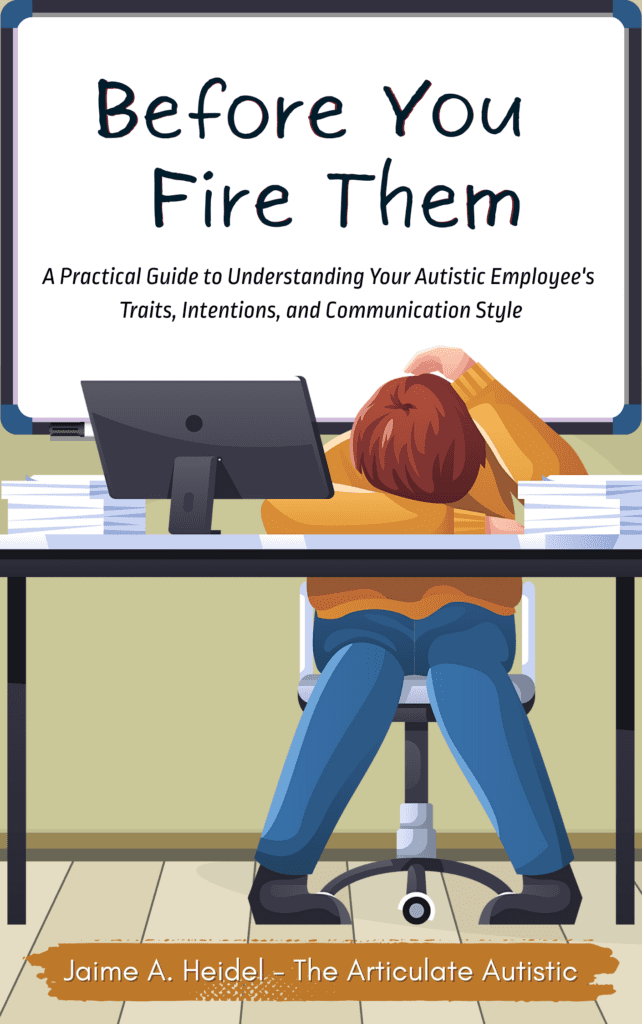
Learn more about how communication styles differ between autistic and neurotypical employees by picking up your copy of my book, Before You Fire Them: A Practical Guide to Understanding Your Autistic Employee’s Traits, Intentions, and Communication Style.
You’ll learn how to boost productivity, improve employee morale, and reduce friction in the workplace from day one!