What an Autistic Brain Is Doing During a “Simple” Chat With a Neurotypical Person

Many autistic people describe how draining it can be to hold a casual conversation with a neurotypical person. Memes, posts, and jokes about this are everywhere. What is harder to find is a clear, moment-by-moment look at what is happening inside the autistic person’s brain while that “simple” chat is taking place.
That is what this story aims to show.
Mara and Jen are not close friends, but they see each other often. Both are parents, and they tend to chat at the park while their children play nearby.
Mara is autistic. Jen is neurotypical. Each has one child, both five years old. Mara’s son is named Noah. Jen’s daughter is named Lily.
On this particular afternoon, the two mothers are sitting side by side on a bench. Their children are climbing on an overcrowded jungle gym a short distance away.
Jen, chewing enthusiastically on a granola bar, starts talking. “So, Lily did the cutest thing this morning,” she says.
To Mara, the sound of chewing is overwhelming, like a muddy stampede pressed directly against her ears. She forces herself to stay in the conversation. “Oh?” she says aloud.
Inside, her thoughts are racing. Look at her face. No, not at the crumbs on her lip. Focus on a neutral point. The bridge of her nose, maybe. Wait, what did she say? Cute. Something cute. Lily. Right. Lily is adorable. Those marshmallow-like cheeks. You could squeeze them for days. No, come on, pay attention.
Jen keeps going. “And then she smiled and said, ‘Oopsie. It was adorable,” she adds.
Jen pauses, still chewing, clearly expecting a response. The seconds stretch. Mara feels panic rising and pulls together a reply. “Lily is always adorable,” she says.
Jen beams, pleased. She takes a long drink from her water bottle. Mara flinches at the sound of liquid and saliva moving together down Jen’s throat, the thick glugging amplified in her awareness.

A sudden shriek cuts through the air. Both women snap their attention to the playground. Jen leans forward, scanning the crowd of children. Mara presses a finger into one ear, squinting through her sunglasses to find Noah.
Neither child is hurt. The noise came from a baby who had apparently discovered that screaming is entertaining. The baby keeps shrieking. Each burst of sound hits Mara like a physical jolt. She winces.
Jen resumes the thread she had started a moment earlier. “So, we thought we would go see that movie this Saturday,” she says.
Mara, still blocking one ear, scrambles to catch the topic. Movies. Right. Movies. I can handle this. “I am a really big fan of horror movies, but I cannot stand gore,” she volunteers.
Jen squints at her. “No, I meant the new rom-com that just came out,” she replies.
Mara’s mind lurches. Wait, you misheard. Fix it. Also, her eyes are doing that confused thing again. Out loud, she says, “Oh, I am sorry. What was the title again? Eric and I might go see it.” The child on the jungle gym continues to scream, and Mara’s brain feels like it is buzzing.
“Layers of Love,” Jen replies, still looking puzzled. “I thought you said your husband hates romantic comedies,” she adds.
Make a joke. Open your eyes wide. Blink fast. Smile. Try to look amused. “Oh, I thought you said Layers of Blood,” Mara says, laughing lightly.
What Mara is doing in that moment is called masking. Many autistic people learn to copy expressions, tones, and reactions that help us pass as neurotypical. It is a survival skill in a world that often punishes visible differences.
What Mara is doing in that moment is called masking. Many autistic people learn to copy expressions, tones, and reactions that help us pass as neurotypical. It is a survival skill in a world that often punishes visible difference.
Jaime A. Heidel
Jen laughs nervously. “Yikes. I do not want to know how there would be layers of it,” she says.
Mara lifts a hand to her face and shakes her head as if she is simply being silly. “I know. Creepy. I must have misheard you. All this noise,” she replies.
Jen glances at the playground and back at Mara. “Noise? Oh, ha. I am so used to it, I do not even hear it anymore,” she says.
Mara feels a wave of fatigue slam into her. The edges of her surroundings start to blur. Her face relaxes, her eyes go distant. “You really do not hear it?” she asks.
Jen’s expression shifts to concern. “Are you okay?” she asks.
Mara realizes, with a jolt, that her mask is slipping. Your voice is too flat. Add inflection. Smile. Fix your eyes. “Yes, I am fine. Just a bit tired,” she says.
Jen does not look convinced. “You say that a lot. Do you have trouble sleeping? I do sometimes,” she says.
Mara does not want to lie, but the truthful answer would require explaining sensory overload, masking, and burnout. She does not have the energy. She reaches for something more familiar. “Eric snores,” she says.
Jen relaxes at once, nodding. “Ah, Ryan snores too. Earplugs. Wear them. They will change your life,” she says.
Almost on cue, another child screams dramatically.
Mara flinches. “I wish I had a pair right now,” she mutters.
Jen’s face hardens. She stands up quickly. “Lily?” she calls.

Lily runs over, sobbing, with a freshly-skinned knee. She is crying loudly and clinging to her mother.
Oh no, Mara thinks. I just complained about the noise, and now her child is crying for a completely valid reason. That sounded awful.
Jen comforts her daughter, but every so often she shoots Mara a sideways look that is hard to read.
Mara, unsure how to repair the situation, asks, “Is she okay?”
“She is fine,” Jen answers, her voice clipped.
Abort mission, Mara thinks. Get out. Find a believable excuse. Fast. “I should probably get going. I am getting a headache,” she says.
Abort mission, Mara thinks. Get out. Find a believable excuse. Fast. “I should probably get going. I am getting a headache,” she says.
Jaime A. Heidel
Jen’s mouth falls open. “Well, sorry that my hurt, crying child is bothering you so much,” she snaps.
Mortification washes over Mara. No, that is not what you meant. Explain. Quickly. “Oh no, Lily is not bothering me. That is not what I meant. I am just tired, and my head hurts. I was not thinking. Is there anything I can do?” she asks.
Jen raises an eyebrow. “No. I mean, it is just a skinned knee. She is okay,” she says.
Mara stands up and sways a little. “Noah, honey,” she calls.
Noah runs to her side. He looks worn out, too. Mara picks him up and carries him toward the car, mumbling a weak goodbye over her shoulder.
Jen watches them leave and wonders if Mara is on something. If that is the case, she does not want it near her daughter. She makes a mental note. Maybe next week she will take Lily to a different park across town.
For neurotypical readers, this is a glimpse into our daily reality.
Scenes like this play out between autistic and neurotypical people all the time. The misunderstandings and misread signals wear everyone down.
That is why it matters so much to understand what is happening on both sides, so that we can adjust how we communicate, reduce harm, and make everyday interactions less painful for all of us.
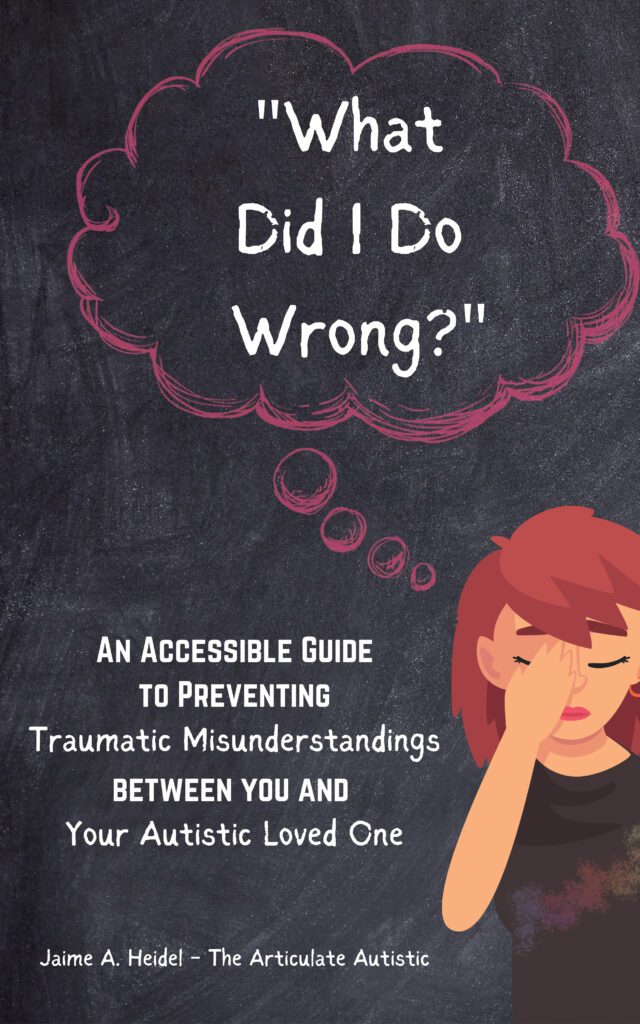
Learn more about your autistic loved one’s intentions, experiences, and way of communicating with the world. Reduce meltdowns and experience more peace and understanding for both of you by picking up a copy of my book, “What Did I Do Wrong?”