Poverty Is Not a Behavioral Problem
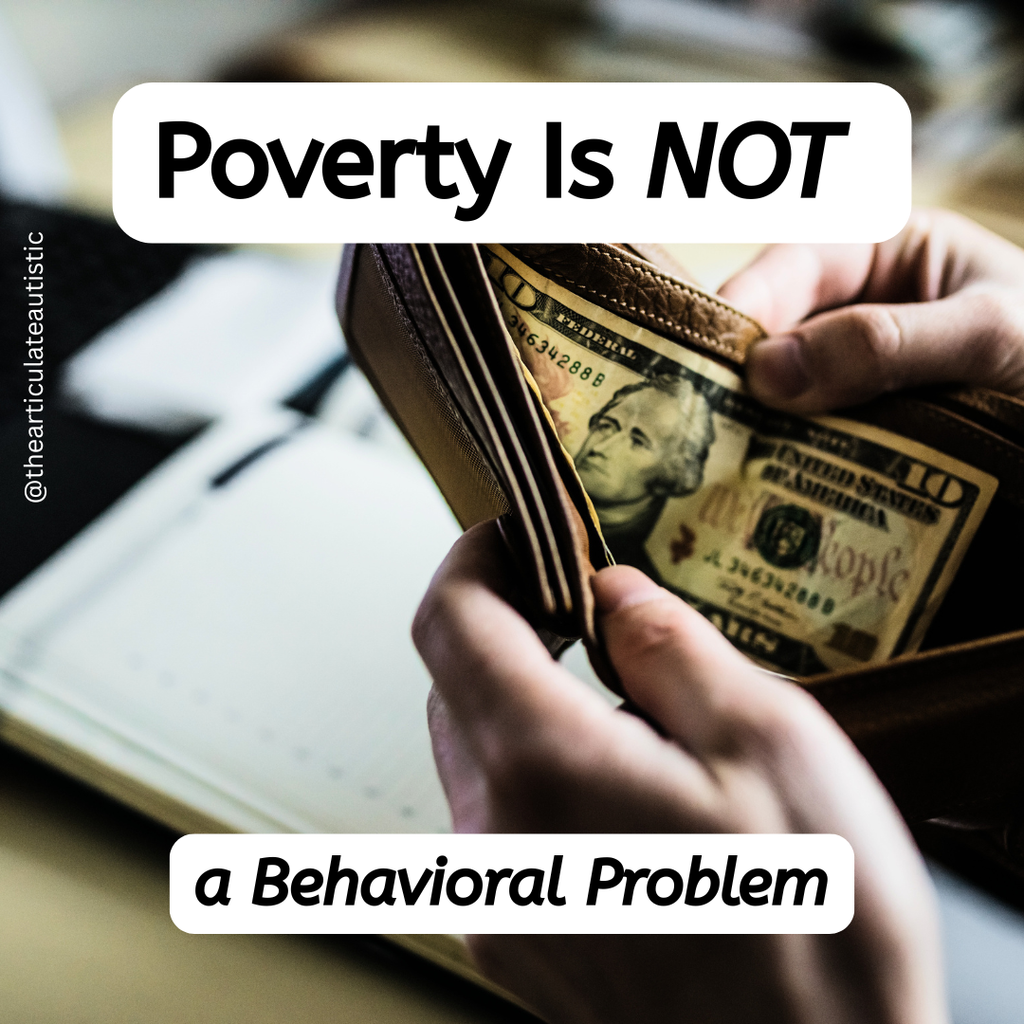
Poverty is poverty. It doesn’t discriminate by age, social standing, political or religious affiliation. It’s a symptom of a systemic worldwide problem with billionaires making more money while we continue to make less.
However, I will say that autistic, neurodivergent, and other disabled people are disproportionately affected by poverty because we often are unemployed or underemployed, which further limits our resources.
These are things people in poverty should never have to hear (but frequently):
“You need to reduce your spending.”
When your bills cost more than your income, reducing spending will not help because there is nothing to reduce. We’re not talking about uncontrollable spending, we’re talking about people simply trying to survive.
When you tell people to reduce their spending when they cannot even get their basic needs met, it means you’re telling them to cut out food, electricity, heating, garbage, hot water, or some other important bill when all of these are necessary to sustain human life.
“Can’t they just get benefits?”
Um, yes and no. Personally, I have been trying to get back on EBT (food stamps) and Medicaid (I used to have both with no problem) for the better part of two years now. Even though I should qualify based on my income, I have been turned down twice, and these people do not give reasons why.
Also, there are very strict requirements to get benefits such as food stamps, Medicaid, and energy assistance. Most people are turned down if they make even just a little bit of money over these requirements.
“You need to make more income.”
This one has never made sense to me. If someone is disabled and can’t work, then how can they make more income? Too many people believe that if you can hold what they view as a “normal” conversation and can also type and drive, you must be able to work.
No. It doesn’t work like that.
For autistic people, there are many, many barriers to finding and keeping employment.
For example:
- Many companies, even work-from-home companies, make candidates take “personality tests” given by AI, and the candidates are often automatically disqualified before it even gets to a manager. This is because autistic people often misunderstand these questions because they take them literally, they have nothing to do with the job itself, and that doesn’t make sense to them, or they don’t answer the way a neurotypical person would.
- When an autistic person does secure a job, it is often inaccessible to them because the company knows little to nothing about autism and does not provide accommodations.
- Frequent misunderstandings caused by differences in communication between an autistic employee and their neurotypical manager often causes enough friction that they’re fired soon after they land the position.
- Neurotypical people often don’t get along with autistic people because, to their brains, something about them seems “off”, which causes the autistic person to be pushed or bullied out of the company over time.
- Another reason autistic people are fired frequently is due to autistic burnout (which is different from neurotypical burnout). This can cause the autistic person to be unable to produce work at the speed and accuracy that their boss is used to because their nervous system is breaking down. This is often immediate grounds for dismissal.
“Then, why don’t they just work fast food or retail?”
- Fast food and retail are customer-facing jobs. If the autistic person doesn’t have facial expressions, or they have a monotone voice, or if they speak their mind directly, they’ll have multiple complaints from customers and be fired.

- Also, fast food and retail jobs are BRUTAL. While even neurotypical people find these jobs and the customers challenging enough to go into the back and cry after some encounters, the autistic person has the added layer of needing to “mask” their autistic traits for 8 to 10 hours straight, which puts an incredible strain on their nervous system until it leads to burnout, which reduces ability, energy, and skills for months at a time.
“So, why don’t they just get a work-from-home job?”
- For the same reasons I mentioned above. Almost every company uses these AI “personality tests” where autistic people are immediately weeded out by the AI because of how the autistic person interprets and answers those questions.
- Work-from-home jobs are not a dime a dozen. They can be very difficult to find and often turn out to be scams.
- The autistic person may not have the experience necessary to transfer job skills to a work-from-home opportunity. For example, if they’ve only worked fast food or retail, the company won’t hire them because they don’t have the relevant experience.
- With most work-from-home jobs, there are still multiple interviews they’re expected to go through. As soon as the hiring manager pops into the virtual interview, they will automatically detect something different about the autistic candidate, and even if they have the relevant experience, will decide to go with another candidate before the interview even begins.
“You should ask friends and family to help.”
Autistic people don’t often have a large social network to fall back on in times of financial hardship. They either have never been able to make friends due to the difference in their brain wiring, or the friends they do have are more like acquaintances.
As far as families go, autistic people often can’t find financial support there because they are either estranged from their families due to abuse or they’re mistaken as “looking for a handout” because they’re “lazy” or “incompetent”, not because they have a disability.
As far as families go, autistic people often can’t find financial support there because they are either estranged from their families due to abuse or they’re mistaken as “looking for a handout” because they’re “lazy” or “incompetent”, not because they have a disability.
Jaime A. Heidel – The Articulate Autistic
“Have you tried…?”
Yes.
It’s Expensive to Be Poor
For people who live comfortably, it can be confusing to read something like this. What do you mean, “it’s expensive to be poor”?
Well, think of it this way. If someone is on a very limited budget and they don’t have enough cash for food, an electric bill, a car repair, etc., they’ll use a credit card to cover it. If they don’t make enough money to buy basic necessities, the bill goes on their card along with high interest charges and late fees.
When the next paycheck comes in, the person will make an effort to pay at least part of the debt, but they are often unable to pay anything other than the minimum payment, which, in turn, accrues further interest charges, which, over a long enough time, can make the person’s credit card go over balance, where there are even more fees tacked on that than the person can pay for!
Another reason it’s expensive to be poor is because people who have limited income are unable to buy in bulk or buy quality products. This means they spend twice if not three times as much on staples by buying the smallest amount.
Furthermore, being unable to buy quality clothes, shoes, furniture, etc., means those items will have to be replaced 3 to 5 times as often. If they’d had the cash upfront to buy what they needed in bulk and in better quality, they wouldn’t have to replace those items nearly as often, if ever, and this saves money.
The Difference Between Behavioral Poverty and Situational Poverty
Do some people get in over their heads financially due to their spending habits? Yes. But there is a huge difference between situational poverty (you don’t have the means to meet your basic needs, so you put them on a credit card), and behavioral poverty (you spend far more than you earn on luxury items you don’t need).
My Story
I’ve hardly shared this with people I know, and I’ve never talked about it publicly before, but I feel my transparency can help people who are going through the same thing feel less alone and ashamed.
I’ve carried credit card debt for most of my life. I moved out at 17 because I wasn’t emotionally safe where I was living, and I needed to get away ASAP if I was going to hold onto my sanity.
The reason I’ve carried credit card debt for so long is because living on my own with no support often had me resorting to credit cards just to get my basic needs met.
I didn’t have the support of friends or family, so I had the support of my credit cards. I didn’t always carry large balances, but I always needed them, even when I worked two jobs.
Fast forward to 2026, and I’m about $14K in the hole. My credit cards are nearly maxed, and I cannot put enough on them because even paying the minimal amount can be difficult due to my financial situation. The higher the balances go, the higher the minimum payment and the more interest charges accrue.
This means, charges are added to my monthly balance, so even if I don’t touch the card, I can still go over my maximum credit allowance!
Basically, it’s like trying to bail out the Titanic with a thimble.
I am now working with a credit counselor to help, but even there, I have very little wiggle room due to my income, and I’ll only be able to afford the minimum payments there, too.
The Takeaway
Poverty is not a choice, it is not a moral failing, and it certainly isn’t a behavioral issue. It’s a systemic issue that affects everyone. It’s just that autistic people are more likely to live in poverty due to the reasons I mentioned above.
Please don’t tell disabled people to just “go out and make more money”. If we could, we would.
Don’t consider us lazy because we’re unemployed or underemployed. Don’t think we’re dumb because we can’t hold a job.
For autistic people, it’s rarely about skills or initiative, it’s about social standing, and the fact that autistic people do not look, act, or socialize the same way as their neurotypical counterparts. This makes our managers and coworkers feel like something is “off” with us, until they get enough complaints and let us go.
The next time you meet someone living in poverty or close to it, avoid casting aspersions on them because if you’ve never experienced it, it’s difficult to understand and easy to judge. Instead, take a moment, look at their entire situation, and offer them grace.
Nobody who is just trying to survive paycheck to paycheck needs the added stress of someone telling them they just need to “get their spending under control”. Their financial situation has everything to do with surviving, not buying fancy things.
Remember, poverty is not a behavioral problem; it’s an attempt to survive for just one more day.