Why Autistic Employees Need Clear, Direct Performance Feedback

In many neurotypical workplaces, it is seen as polite and professional to soften negative feedback. Managers hint, use idioms, make light jokes, and rely on tone and facial expressions to signal that someone needs to change what they are doing.
For neurotypical employees, this indirect style often works. The unspoken message is understood: “You need to be on time,” or “You need to sound friendlier on the phone,” even if those words are never said outright.
For many autistic people, that message never lands. We usually do not pick up on the subtle “language” of raised eyebrows, half-smiles, and coded phrases. If no one tells us plainly that there is a serious problem, we may believe everything is fine, right up until the day we are suddenly fired.
If no one tells us plainly that there is a serious problem, we may believe everything is fine, right up until the day we are suddenly fired.
Jaime A. Heidel – The Articulate Autistic
When Autistic Employees Don’t Speak the Same Social Language
Imagine you supervise a team of ten people. Two of them behave differently from the rest.
The first employee consistently arrives ten to fifteen minutes late for work. You dislike this and feel you have made your feelings clear by saying things like, “Lots of traffic this morning?” or “Did your alarm forget to go off again?” or “Need a new battery for that watch?”
To you, these comments obviously mean, “Your lateness is not acceptable.” To a literal autistic brain, they may just be confusing. What do traffic, an alarm clock, or a watch battery have to do with work? He may not realize there is a pattern or that his job could be at risk. He is not unintelligent. He simply does not connect your jokes and hints to a warning about his performance.
He is not unintelligent. He simply does not connect your jokes and hints to a warning about his performance.
Jaime A. Heidel – The Articulate Autistic
Your second employee answers customer calls. She gives accurate information, but her voice sounds flat to you, and she does not make small talk. You worry she is coming across as cold. When you address it, you say things like, “You catch more flies with honey than vinegar,” or “Smile when you are on the phone, customers can hear it,” or “Was that Mrs. Tate? How is the weather in Oklahoma?”
You intend these phrases as a gentle way of saying, “Be warmer and chat more with customers.” She might be thinking, ‘Why are we talking about honey, vinegar, and weather during a work call?’ Once again, there is a mismatch between what you think you are communicating and what she actually hears.
Direct Does Not Mean Harsh or Unprofessional
Many neurotypical managers worry that being direct will make them sound rude or aggressive. But for autistic employees, clear language is not an insult; it is an accommodation.
Telling us plainly what is wrong, why it matters, and what needs to change is not unprofessional. It is treating us fairly by making expectations accessible. In a mixed team, using indirect hints for some and clear statements for others simply means you are speaking to each employee in the way that works best for their brain.
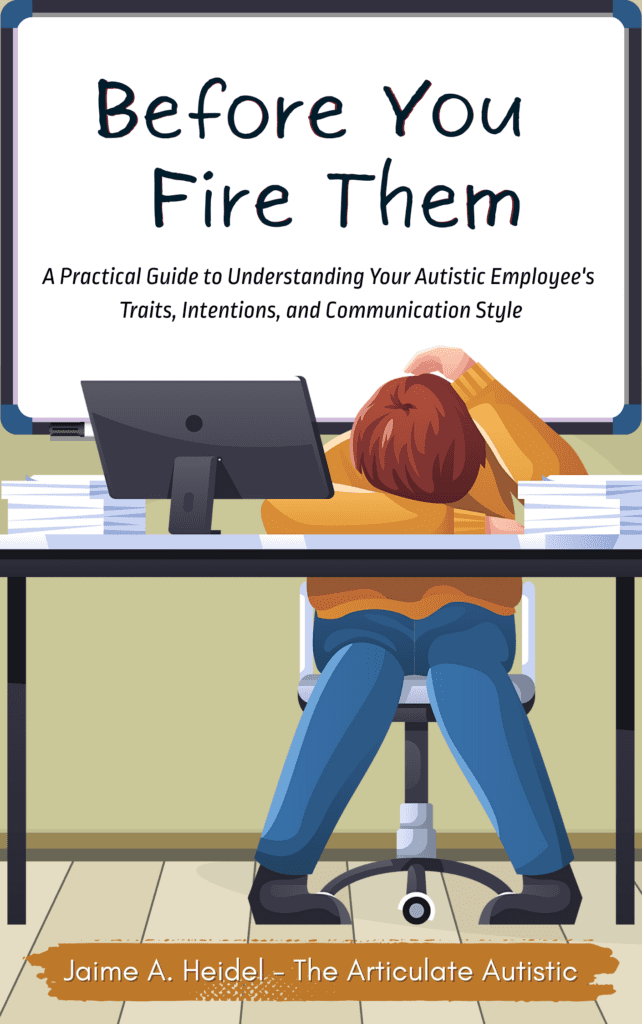
Better understand your autistic employee’s traits, intentions, and communication style by picking up a copy of my new book, Before You Fire Them!
A Better Way to Address Lateness
With the chronically-late autistic employee, set up a one-on-one meeting at an agreed time. In that meeting, say directly:
- “You have been arriving 10–15 minutes late most mornings for the last few weeks.”
- “This is a problem because [explain the impact: coverage, customer service, team workflow, etc.].”
Do not assume, “Everyone knows you should be on time.” Autistic people often need an explicit explanation of the “why” behind rules in order to fully understand and remember them.
Also keep in mind that many autistic and ADHD people struggle with what is often called ‘time blindness’, a real difficulty sensing how much time is passing. He may genuinely not realize how late he has been.
Finally, work with him to find solutions: alarms, visual timers, adjusting schedules where possible, or negotiating flexible start and end times if your business can support it.
A Better Way to Address Phone Tone and Small Talk
For the employee whose phone manner worries you, use the same approach. Arrange a private conversation. Describe, in neutral language, what you are hearing:
- “Your tone on the phone sounds very flat to me.”
- “You give accurate information, but you rarely make small talk.”
- “I am concerned that some customers may feel you are being abrupt, even if that is not your intent.”
Be aware that many autistic people cannot hear their own tone, volume, or inflection the way others do. She may be surprised to learn how she sounds from your perspective.
Be aware that many autistic people cannot hear their own tone, volume, or inflection the way others do. She may be surprised to learn how she sounds from your perspective.
Jaime A. Heidel – The Articulate Autistic
Then, explain your expectations and the reasoning:
- “Part of this role is sounding warm and welcoming, because that matches our brand.”
- “We expect a short bit of small talk with most customers, and here is why.”
After that, brainstorm together. Maybe you can agree on a few simple phrases she can keep by the phone or role-play a couple of calls. The goal is not to force her into a fake personality, but to find realistic ways she can meet the job requirements.
A Note on Masking
In this second example, you are asking your autistic employee to change her natural voice and behavior to fit a neurotypical standard. This is a form of masking.
Masking is extremely draining over time. It means constantly monitoring and editing how we talk, move, and react so that we will not be judged or punished. Long-term masking can seriously affect mental health.
That does not mean you can never ask for adjustments. It does mean you should talk honestly together about what is sustainable for her and what support she might need if the role demands a high level of constant masking.
The Takeaway
Side comments, hints, and coded phrases may feel polite, but they are not effective performance feedback for most autistic employees.
Scheduling straightforward, one-on-one conversations where you clearly describe the problem, explain why it matters, and work collaboratively on solutions creates a fairer workplace for everyone. Direct communication does not lower your standards; it simply gives autistic employees a real chance to meet them.