Why Autistic People Are Especially Vulnerable to Manipulation
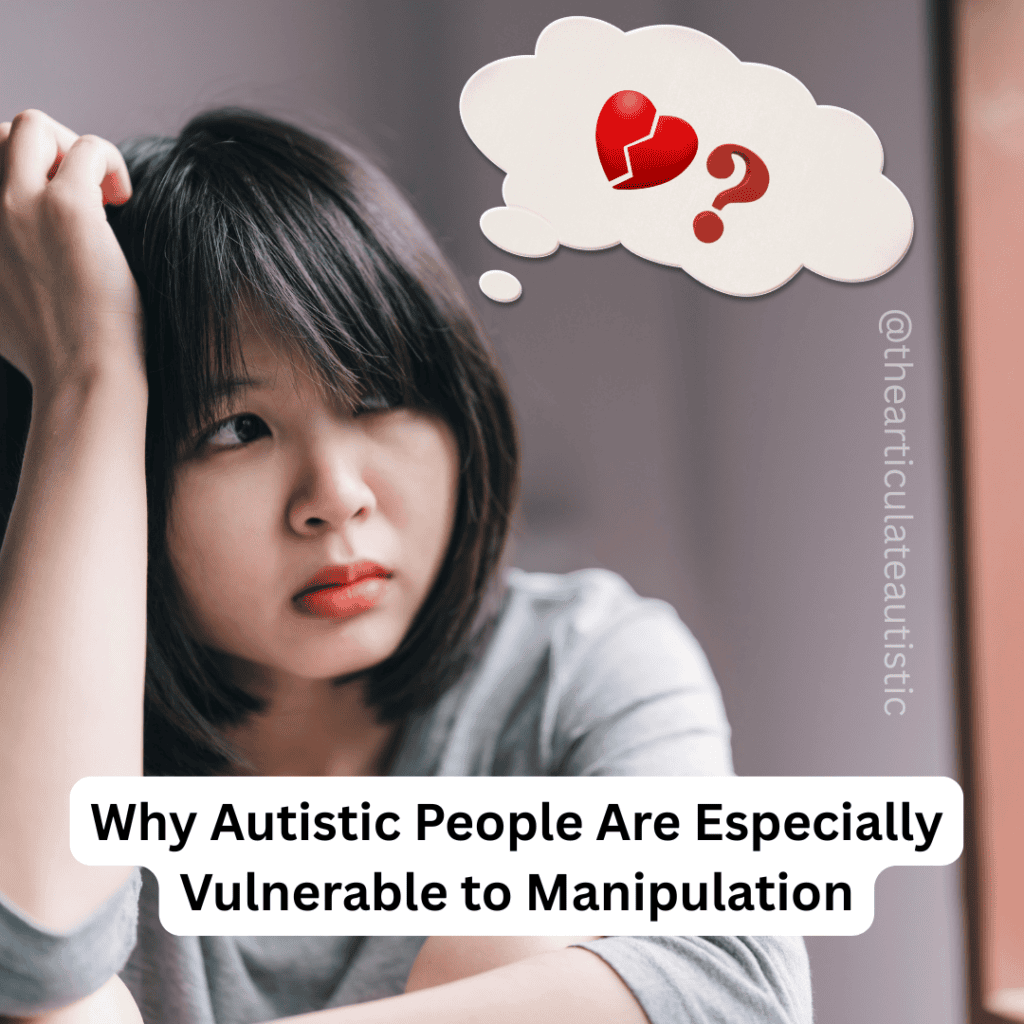
Autistic people are especially vulnerable to manipulation, mistreatment, and being taken advantage of. If you’re autistic and want to understand why this happens (or if you have an autistic loved one you see going through regularly), this article is for you.
You’re not paranoid. This is a very real thing, and there are studies to prove it.
According to a study published in Frontiers in Psychiatry, “Participants with ASC (autism spectrum conditions) reported experiencing, as children, more overall victimization; specifically, more property crime, maltreatment, teasing/emotional bullying, and sexual assault by peers, compared to participants without ASC.”
According to another study, published in Autism in Adulthood, “Our findings suggest that autistic adults experience victimization from a range of close others, and may find it difficult to recognize when someone is acting in an abusive manner.”
Why Autistic People Get Taken Advantage Of
Let’s take a look at why autistic people often get taken advantage of:
- Literal thinking and direct speech
Autistic people are literal and straightforward in their approach to language and communication. They say what they mean, and they mean what they say, so autistic people often don’t realize others don’t communicate like this.
Furthermore, an autistic person’s tendency to take everyone at their word can make red flags invisible and requests from abusive people seem perfectly acceptable–even if they’re dangerous or inappropriate.
- Tendency to trust others
Autistic people, by and large, are trusting, helpful, caring, and kind. Therefore, especially when they’re younger, they can’t imagine that not everyone is the same way. Bullies and toxic people pick up on this and take advantage of their innocence.
- Delayed emotional processing
In addition to being literal and straightforward, many autistic people have what is known as ‘delayed emotional processing’ along with alexithymia.
Alexithymia is a difficulty in understanding one’s own emotional state, which can affect the ability to detect abuse, especially if it’s subtle. Alexithymia can also make us unaware of how this mistreatment is affecting us.
With delayed emotional processing, the autistic person might be bullied by their supposed “friends”, and weeks, months, or even years will go by before they realize it. Also, many autistic people tend to gaslight and convince ourselves that it’s “all in our head” because that’s what we’ve been told our whole lives!
Think about it:
“It’s not that loud.”
“It’s not that bright.”
“Calm down. You’re fine.”
“There’s no need for theatrics.”
It’s no wonder we grow up not trusting our own experiences and intuition! When we look to others for what is “right”, we unintentionally open ourselves up to being taken advantage of.
- Inability to access subtle social cues
When two autistic people converse, they use literal and direct language. There’s no decoding. However, when neurotypical people communicate, they often use subtle facial expressions, body language, and tones of voice meant to communicate underlying meaning and feelings that we autistic people can’t detect.
When an autistic person who communicates in a straightforward manner discovers that neurotypical people use subtle communication, it’s like a computer experiencing a 404 NOT FOUND error.
When an autistic person who communicates in a straightforward manner discovers that neurotypical people use subtle communication, it’s like a computer experiencing a 404 NOT FOUND error.
Jaime A. Heidel – The Articulate Autistic
Furthermore, if a neurotypical person feels that their feelings are being ignored or unmet (even though the autistic person cannot access their subtle communication), they may be more inclined to be mean to the autistic person to “get back at them” (because they think the behavior or lack thereof is purposeful) whereas the autistic person doesn’t understand where their anger is coming from.
- Lack of social protection
Another common reason autistic people are used and abused is because we have a lack of social protection. In other words, we aren’t part of a social group that will stand up for us. We’re all on our own, and the friends we do have are often signaled out for bullying just as much as we are.
This has to do with social hierarchy. For neurotypical people, everyone is on a social hierarchy tier, and what tier you fall into (or if you’re even up there at all) can make you more vulnerable to mistreatment.
For abusive people, this is like a lion going for the slowest-running antelope in the herd. It’s just easier for them.
- History of abuse
Many autistic adults have a history of abuse within their families. Since they acted in ways that neurotypical people didn’t understand, they were often signaled out, mistreated, punished, and constantly corrected for doing things “wrong”. That can result in post-traumatic stress disorder (PTSD), which can change our brain wiring, and, ironically, cause us to be even more drawn to toxic people.
Also, similar to having no social group to defend you, once they find out your own family won’t even protect you, or they mistreat you, abusive people can sense that like a shark smells blood, and they’ll come around in droves to add to that abuse.
- Tendency to offer solutions
As an autistic person, my way of showing empathy is very different from how neurotypical people show it. I’ve always found just listening, nodding, and saying, “That must be so hard” to be inadequate and condescending. Like you don’t even care, you’re just regurgitating platitudes.
Like you don’t even care, you’re just regurgitating platitudes.
Jaime A. Heidel – The Articulate Autistic
Apparently, however, this is how neurotypical people feel heard. This is what empathy is to them. So, when we don’t show it, it triggers anger and dislike.
Since autistic people show empathy by offering solutions instead of just an ear, this can draw toxic people to them to try to get them to fix all of their problems to the point of great emotional cost, leading to shutdown and burnout.
And, again, due to the delayed processing or alexithymia, the autistic person may feel sick, drained, tired, irritable, and depressed without realizing that it’s the abusive people around them causing it!
The Takeaway
As an autistic person, please understand that none of this is your fault. You don’t deserve to be taken advantage of or manipulated because your brain works differently. Being vulnerable, open, kind, and trusting are beautiful gifts that you should cherish.
However, if you continually find yourself in abusive friendships and relationships, you may need to learn vital information to protect yourself. I recommend learning about boundaries and what they look like, as well as signs of subtle abuse and red flags.
Further reading:
Articles:
Books:
Bullies, Narcissists, Liars, and Manipulators: A survival guide for dealing with difficult, negative, and toxic people by Serena Ellison
Beating the Workplace Bully: A Tactical Guide to Taking Charge by Lynne Curry