Why Neurotypical Frustration Can Intensify Autistic Anxiety
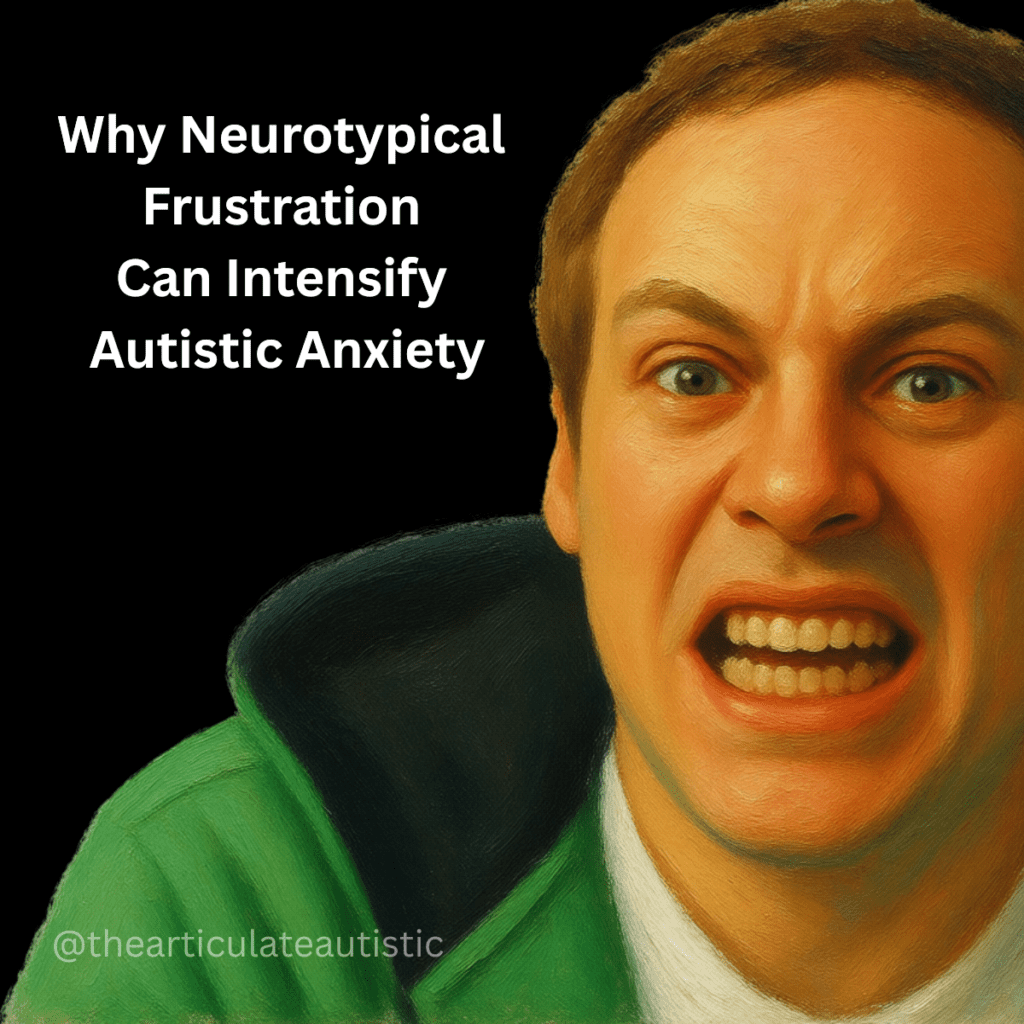
There is often a lot of confusion when autistic people talk about how neurotypical frustration affects us. Some people hear that and assume we are demanding that neurotypical partners, friends, or family members never feel upset, never express anger, and never show frustration at all. That is not the point.
Frustration and anger are normal human emotions. There is nothing inherently wrong with feeling them, and there is nothing wrong with expressing them. The issue is that the way those emotions are expressed can have an enormous impact on an autistic nervous system.
For many autistic people, neurotypical frustration can magnify anxiety tenfold. That does not mean neurotypical people are bad. It means the autistic person’s system is often already running with a high baseline of anxiety, and certain forms of emotional expression can push it quickly into overload.
The False Either-Or
When this topic comes up, people often jump to black-and-white solutions. Should neurotypical people keep every feeling inside and pretend everything is fine? No. Should autistic people simply mask harder so they frustrate others less? Also no.
Those are not the only two options, yet they are often treated as if they are. The real solution is not emotional suppression on either side. The real solution is learning how to express difficult emotions in ways that do not send the autistic person’s alarm system into crisis mode.
It Is Not Just the Words or Tone, It Is the Energy
Neurotypical people often say, “It is not what you say, it is how you say it.” With autistic people, there is a twist. Often, it is not just what you say, or even how you say it, it’s the energy behind it.
An autistic person may notice that your words sound gentle while your body is tightly wound, your jaw is set, your movements are sharp, and your emotional energy feels volatile. That mismatch can feel deeply unsafe. If your face is smiling but your body is broadcasting barely controlled rage, the autistic person may react as if danger is present.
An autistic person may notice that your words sound gentle while your body is tightly wound, your jaw is set, your movements are sharp, and your emotional energy feels volatile. That mismatch can feel deeply unsafe.
Jaime A. Heidel – The Articulate Autistic
That is why some autistic people describe this kind of interaction as feeling like being offered an apple with a razor hidden inside. The surface looks safe, the underlying threat does not.
Why the Usual Conversation Stops Working
When autistic anxiety spikes in response to that energy mismatch, the original issue often becomes impossible to address. The nervous system shifts into survival mode. The person may want to flee, shut down, argue, or melt down. Whatever task, behavior, or misunderstanding you were frustrated about is now even less likely to be resolved.
So if the goal is meaningful communication, barely-controlled rage wrapped in polite words usually works against that goal. It does not create insight; it creates panic.
What to Do Instead
This does not mean you have to hide your feelings. It means you may need to slow yourself down enough that your internal state and your outward communication are no longer at war with each other.
If you are getting close to the point where you want to yell, throw something, or explode, take a minute. Drink some water or coffee. Look across the room. Count a few objects you can see. Let your breathing settle. Give the storm a chance to come down before you try to talk.
That pause is not avoidance; it is preparation for a conversation that actually has a chance of working.

Leading With Warmth Instead of Threat
One practical strategy is to deliberately reconnect to your feelings of care before you re-enter the conversation. Think about why you love this neurodivergent person. Think about their humor, creativity, loyalty, tenderness, or the qualities that make them matter to you.
Let those warmer feelings change your body. Let your shoulders drop. Let your face soften. Let your voice lose its edge. Try to approach the person not as the source of a problem, but as someone facing a problem with you and needing help to solve it.
That shift in energy can dramatically change how the autistic person receives what you are saying.
Direct Language Helps, Too
If you need space, say so clearly. You might say, “I am too frustrated right now to explain this well. Give me ten minutes, and then we’ll try again.” That kind of statement is far less destabilizing than staying in the room while radiating anger you are trying to disguise.
That kind of statement is far less destabilizing than staying in the room while radiating anger you are trying to disguise.
Jaime A. Heidel – The Articulate Autistic
If the autistic person becomes confused or hurt by the pause, honesty helps. You can explain that your emotions are too activated and that you need a short reset before the conversation can be productive.
When Outside Help Is the Best Option
If the two of you repeatedly cannot talk without escalating into major frustration, that is often a sign that you need support, not that one of you is broken. A therapist or mediator can help translate the communication gap and show both people what the other is missing.
Getting help does not mean the relationship is doomed or that someone is deeply disturbed. Sometimes it simply means you are speaking two different emotional languages and need a guide.
The Takeaway
Neurotypical frustration is not wrong. Autistic anxiety is not wrong, either. The challenge is finding forms of expression that do not accidentally turn every difficult conversation into a threat response.
When frustration is slowed down, grounded, and shaped by genuine care, autistic people are much more likely to stay present and engaged. That gives both people a better chance of being heard, understood, and supported.
The Book That Helps You Better Understand Your Autistic Loved Ones
Prevent constant misunderstandings by picking up a copy of my book, “What Did I Do Wrong?”: An Accessible Guide to Preventing Traumatic Misunderstandings Between You and Your Autistic Loved One