An Unspoken Social Rule That Gets Autistic People Fired
Autistic people are disproportionately fired from their jobs, and they’re never told why. Their boss may offer a vague explanation, such as, “You’re not a good culture fit,” or “Our business needs have changed”, but that doesn’t give any real feedback about why you’re suddenly out of a job.
And this often happens more than once to autistic workers. They find a job that fits their skill set, interview well, and even go above and beyond in productivity, but three or six months down the line, the energy begins to change.
Coworkers who were once friendly are now short with them, they suddenly find themselves left out of important conversations, and the boss is constantly calling them into the office to talk about “attitude problems” and not “being a team player”.
But rarely, if ever, do managers actually explain what this means.
After all, as an autistic person, you don’t think you have an attitude problem because that’s not how you feel inside. Also, you’ve been nothing but friendly to your coworkers, and you’re acing your job performance, so what the heck is going on?
One day, you’re called into the office and not reprimanded, but fired. You get no answers, and it’s right back to square one all over again.
Being Continually Fired Causes Trauma
When this cycle happens 3, 5, 15, or even 20 times, the autistic person eventually collapses under the strain of it all. It’s always the same thing, but nobody, not one person will reveal what exactly it is that continually makes you an office pariah.
After a while, the idea of working is just too much. You’re burnt out, on the edge of a breakdown (or you’ve had one), and you have nothing left to give to any job, not even stocking or bagging groceries.
The painful confusion of not knowing is slowly eating away at you one day at a time.
The Unspoken Social Rule
What managers will never tell you (because many don’t consciously know it themselves) is that socializing, being likeable, and fitting in take precedence over the work itself.
Yes, you read that right, and you’re never going to find it in an employee handbook.
Don’t get me wrong, your boss wants you to do your work and be productive, but they value social cohesion a bit more than their bottom line. Like I said, they’ll never tell you this because most of the time, they don’t know. They don’t even think about it.
Don’t get me wrong, your boss wants you to do your work and be productive, but they value social cohesion a bit more than their bottom line.
Jaime A. Heidel – The Articulate Autistic
Explaining Socializing Feels Like Explaining Breathing
The thing is, the neurotypical brain is wired for socializing. Their brains automatically read subtle facial expressions, body language, and tones of voice with no effort.
Therefore, they know instantly if someone is annoyed with them, happy to see them, jealous of them, etc., and they adjust their social behavior to match that person’s needs in the moment.
And, amazingly, this is something that happens hundreds of times a day, and neurotypical people can keep up with little to no problem! (This isn’t to say neurotypical people don’t experience their own social struggles, but it’s different.)

Because of this, when a manager insists on having a talk with you about how you come across as rude, standoffish, or uncaring, they think you already know exactly what they’re talking about. Having to explain what it is you’re not picking up on organically feels like having to explain how to breathe. It is so outside of the scope of their experience that they can’t even fathom it!
Due to this, when you get emotional and ask question after question about what you did wrong, and tell them you need specifics, they don’t see your earnest desperation to understand; they see you as pretending to not understand, making excuses, or trying to avoid accountability.
Like losing the job itself, this is a very, very traumatic experience for autistic people.
Let’s Break It Down
After reading this, you may feel triggered, confused, and even angry. That’s completely valid. Nobody tells you the rules because neurotypicals are born with that particular ‘software’ downloaded.
Since we’re not, I’ll break down work social expectations as I wish someone had done for me when I was in the working world.
Here is what’s expected of you:
“Good Morning!”
You’re expected to say ‘good morning’ to your coworkers when you begin your day. (If someone is on the phone or otherwise busy, you can just wave and smile.) You’re also expected to say ‘good night’ at the end of your work shift. Neurotypical people have a strong need for regular recognition. It makes them feel respected and comfortable.
Connecting Throughout the Day
You’re expected to appropriately socialize throughout the day. This means focusing on your work, yes, but when you have break time, run into a coworker in the hall, or when someone comes up to your desk, you’re expected to engage in at least some small talk.
Break the Ice Before Asking for Something
If you need something from a coworker, you’re expected to start with small talk instead of simply stating your needs.
For example, you need to borrow Jeannette’s stapler. Your natural inclination would be to directly ask and, if given permission, grab the stapler. Jeannette, however, might find that approach abrupt and rude and take such issue with it that she goes to the boss, citing ‘hostile behavior’.
(No, I’m not making that up.)
For example, you need to borrow Jeannette’s stapler. Your natural inclination would be to directly ask and, if given permission, grab the stapler. Jeannette, however, might find that approach abrupt and rude and take such issue with it that she goes to the boss, citing ‘hostile behavior’.
Jaime A. Heidel – The Articulate Autistic
Your neurotypical coworkers expect a little small talk such as, “Hey, how’s your day going?” before asking for the favor. (Bonus points if you can remember Jeannette’s dog had surgery last week, and you ask after his health.)
Navigating Meetings
During meetings, you’re expected to look engaged, take notes, and verbally contribute to the conversation. However, here’s where it gets tricky for autistic folks, if you just blurt out an idea (even if it’s a money-saving marvel), those higher on the corporate ladder than you (CEOs, executives, managers) will take immediate issue with this because, based on neurotypical social hierarchy rules, this approach is disrespectful coming from an ‘underling’. Your best bet is to wait until they get to the ‘questions’ portion of the meeting before speaking up.*
* Also, instead of presenting the idea outright, deadpan, and to the point (like we autistics naturally do), it will land better if you act a little hesitant and unsure before presenting your thoughts. I know, I’m teaching you to mask, but sometimes it’s necessary to at least know these tricks, even if you never plan on using them.
Example: “I happened to notice something the other day. It may be nothing, but would it streamline the process if we did A, B, C, instead of X, Y, Z? I think it can shave half an hour off each of the new projects coming in.”
Social Functions
This is an expectation that often trips autistic people up because when managers invite their employees out for things like lunch, Happy Hour, or other off-hours event, they appear to offer it as an option with statements such as, “If you can make it,” or “If you have time.”
Spoiler Alert: It’s NOT an option.
“If you can make it”, often translates to, “Be there, or we’ll think you’re acting too good for us and don’t actually want to be part of the team, and we’ll slowly freeze you out and eventually bully you out of your job.”
Scary, isn’t it?
“But Wait, I Have Accommodations!”
If you’ve disclosed that you’re autistic at work, and they have provided accommodations that help make getting through your workday easier, make sure your boss understands that limiting social interaction is as paramount to your health and well-being as other accommodations (if not more so).
“I Can’t Do This, Sorry”
Ultimately, you don’t have to. You shouldn’t have to. I wrote this article so you would know what it is you’re considered to be “doing wrong”; and you’d be armed with important information.
What you choose to do with this is entirely up to you.
Masking is hard if not impossible for many autistic people, and doing it can burn you out fast. I’m not advocating for masking, but I am giving you some tips on how to do it should you decide to.
The Takeaway
Up until now, you may have had no idea, none, that any of these things were expected of you on the job. Now you do. Society has a long way to go before accepting autistic people as we are, lack of socializing and all, but right now, some of us are out here fighting to survive, and if I can help, I will.
Should you have to do things that seem arbitrary and contrary to your neurology? No, of course not. Education is incredibly important here, and more companies need to understand at least the basics of the autistic brain to make work a positive experience for everyone.
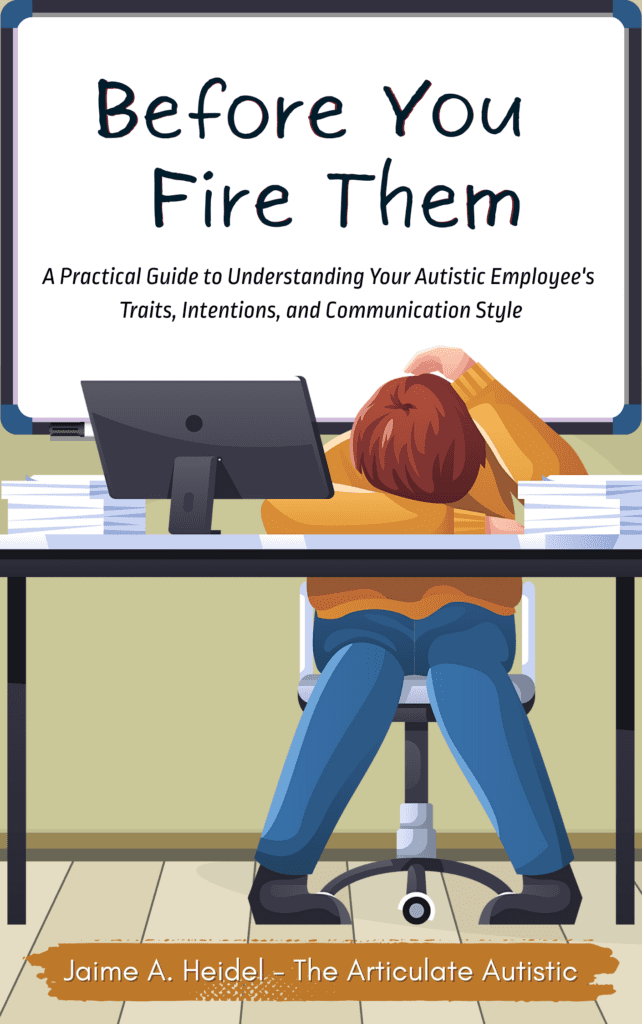
This is why I wrote my book, “Before You Fire Them: A Practical Guide to Understanding Your Autistic Employee’s Traits, Intentions, and Communication Style”. It’s meant to help managers become better at training, accepting, and working with autistic employees.
However, it could also benefit YOU.
Each page in this guide is dedicated to one autistic behavior that managers misunderstand, followed by the autistic person’s actual intention.
If you’ve ever wanted the inside scoop on what your boss and coworkers are thinking, this is the book for you. It’s eye-opening, easy to read, and can help mitigate conflict between you and your boss from day one!
Pick up your copy online wherever books are sold!